

3 Reasons Engineers Choose Floating Connectors — Reliability, Assembly & Cost
If you understand the structural principles of floating connectors, the next logical question is: what is the actual benefit? Is it worth the switch? This article examines the three core advantages of floating connectors from three distinct angles.
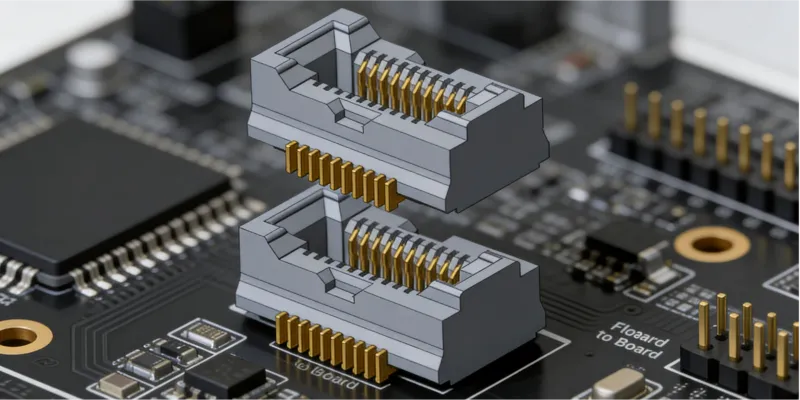
Advantage 1: High Reliability and Adaptability
The most fundamental value of a floating connector lies squarely in reliability.
Multi-Directional Force Absorption Protects Contacts and Solder Joints: Unlike standard connectors, floating connectors can withstand forces and pressure from different directions while allowing the connected component to undergo a certain degree of relative movement with respect to the base. In vibration scenarios, stress from external forces is absorbed by the internal elastic structure rather than being transmitted directly to the contacts and solder joints. This effectively prevents deformation of the contact mechanical structure, degradation of electrical performance such as contact resistance, surface oxidation or poor contact at terminal interfaces, and solder joint fractures caused by mechanical fatigue.
Prevents Solder Joint Cracking: Because floating connectors can absorb external force impacts caused by misalignment or tolerance stack-up during PCB assembly and maintenance, they effectively prevent solder joint cracking from stress concentration. This is especially critical in PCB automated assembly.
Reliable Mating Even on Warped Boards: Some floating connector products also allow displacement along the Z axis (vertical direction) in addition to X and Y — helping to absorb stress caused by PCB warpage or improper installation, further boosting shock and vibration resistance.
Advantage 2: Ease of Assembly
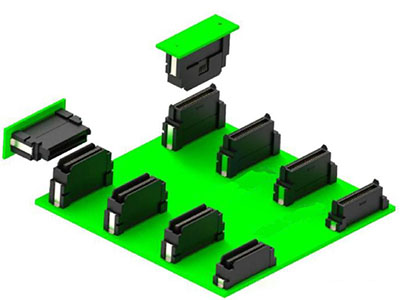
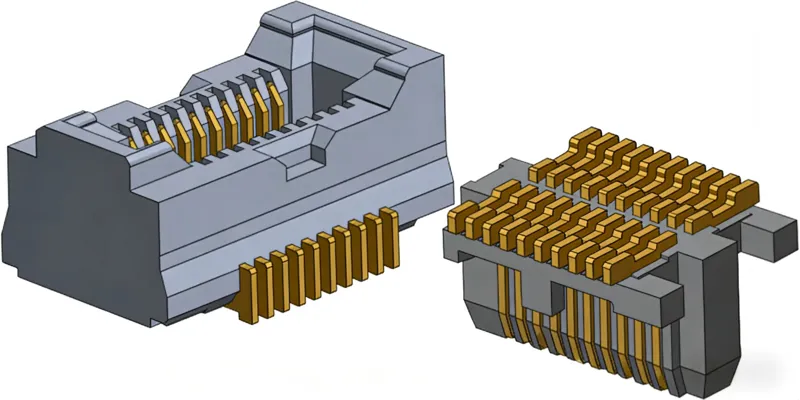
Compatible with Direct Insertion and Automated Assembly: Floating connectors support Pin-in-Paste (direct insertion) and automated assembly processes, giving them superior compatibility with PCB automated assembly workflows. In high-volume production environments, this compatibility can significantly improve throughput and reduce the need for manual intervention.
Reduced Sensitivity to External Shocks and Vibration During Assembly: By reducing the impact of external shocks and vibration, floating connectors achieve better reliability in challenging assembly environments.
Floating Range Assists Correct Mating on Bowed Boards: The built-in floating range also helps achieve correct mating even when boards are slightly bowed or misaligned, significantly reducing assembly difficulty and the risk of damage from mishandling in complex multi-board systems.
Advantage 3: Cost Optimization
The unit cost of a floating connector may be slightly higher than that of a standard connector. But when you view the full picture from a total system cost perspective, the math changes considerably.
Eliminates the Need for More Expensive Flexible PCBs: Using floating board-to-board connectors means you can avoid specifying more expensive flexible printed circuits (FPC) in your design. And because floating connectors support direct insertion and automated assembly, they actively contribute to optimizing overall system costs.
Lower Failure Rate Reduces After-Sales Costs: The high reliability of floating connectors translates directly into lower failure rates, reducing both maintenance frequency and after-sales service costs. In long-lifecycle applications such as industrial equipment and automotive electronics, this benefit is particularly significant.
Improving Total System Value: Using floating board-to-board connectors eliminates expensive FPC usage, improves production efficiency, reduces failure and maintenance costs, and enhances the quality reputation of the end product. This is a small investment, large return system-level cost optimization logic.
Summary Comparison
| Advantage Dimension | Specific Benefits |
|---|---|
| High Reliability | Withstands multi-directional forces, prevents solder joint cracking, resists long-term vibration wear |
| High Adaptability | Allows relative component motion, accommodates misalignment and board deformation |
| Assembly-Friendly | Supports Pin-in-Paste and automated assembly, compatible with SMT processes |
| Cost Optimization | Eliminates need for high-cost FPC, reduces total system cost |
| Ease of Maintenance | No tolerance compensation required in multi-connector boards |
Conclusion
The three core advantages of floating connectors — high reliable mating, ease of assembly, and cost optimization — together form the competitive foundation that allows them to stand out across a wide range of application scenarios. They are not a nice-to-have alternative, but in the right application scenarios, a solution that fundamentally resolves challenges that standard connectors simply cannot handle.
Shenzhen Gaorunxin Technology Co., Ltd