

Ferrite Core Solutions for EV and New Energy Vehicle Power Converters
Ferrite Core Solutions for EV and New Energy Vehicle Power Converters
The automotive industry’s transition to electric powertrains has created demanding new requirements for power electronics. Inverters, DC-DC converters, on-board chargers, and battery management systems all depend on magnetic components that can operate reliably under thermal stress, vibration, and decades of lifetime requirements.
Ferrite cores play a central role in these systems — and selecting the right cores for EV applications requires understanding the unique challenges that automotive environments impose.
Why Automotive Power Electronics Stress Ferrites Differently
Consumer electronics power supplies operate in benign environments — controlled temperature, stable humidity, limited lifespan expectations. EV power electronics face a far harsher reality:
**Temperature extremes**: Under-hood temperatures routinely reach 125–140°C. Junction temperatures in power modules can exceed 175°C. Ferrite cores in these zones must maintain magnetic properties across this full range.
**Lifetime requirements**: Automotive ECUs are expected to operate reliably for 15+ years and 150,000+ km. That means zero degradation in magnetic performance over thousands of thermal cycles.
**Vibration and mechanical shock**: The core must survive substantial mechanical stress without the air gaps shifting or the winding loosening.
**Switching frequencies are rising**: Modern EV inverters and DC-DC converters commonly switch at 10–20 kHz for traction applications, but SiC and GaN adoption is pushing frequencies toward 100–300 kHz — demanding better ferrite materials.
Critical Ferrite Parameters for EV Applications
When evaluating cores for automotive power electronics, these parameters become non-negotiable:
Curie Temperature (Tc)
For under-hood and powertrain applications, you need a material with Curie temperature well above your maximum operating temperature. Standard Mn-Zn ferrites (Tc ≈ 200–230°C) provide adequate margin for ambient temperatures up to 125°C, but you must still account for self-heating from core losses.
For SiC-based converters operating at higher frequencies and power densities, consider TOMITA’s 2G8 grade, which maintains better magnetic stability at elevated temperatures compared to high-permeability grades.
Thermal Cycling and Lifetime
Automotive thermal cycling is brutal: cores experience repeated expansion and contraction as the vehicle heats and cools. This can cause mechanical degradation in poorly matched material-to-frame systems.
TOMITA’s automotive-grade ferrites are tested for thermal shock resistance, with specified ΔT limits for the material grade. When designing, ensure thermal expansion of the ferrite is compatible with the bobbin and housing materials — thermal mismatch is a common cause of premature cracking.
Saturation Flux Density
In high-current applications like DC-DC converters for 400V and 800V battery systems, transient currents can push cores toward saturation. Unlike consumer applications where steady-state conditions dominate, automotive designs must handle cold-crank transients (hundreds of amps for brief periods) without magnetic saturation.
Design headroom: target a maximum operating flux density no higher than 70% of Bs at maximum operating temperature. This gives margin for transient overloads without saturation.
Key Application Areas in EV Systems
Traction Inverter Output Filters
The inverter driving the traction motor produces high-frequency harmonics that must be filtered before they couple into adjacent electronics. LCL filters using ferrite core inductors are standard here.
Core requirements:
– High saturation flux density (handle peak currents during acceleration)
– Low core loss at 10–20 kHz switching (fundamental frequency)
– Robust mechanical design to survive under-hood vibration
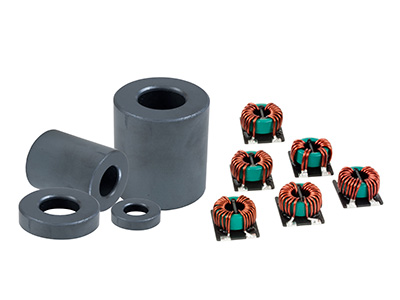
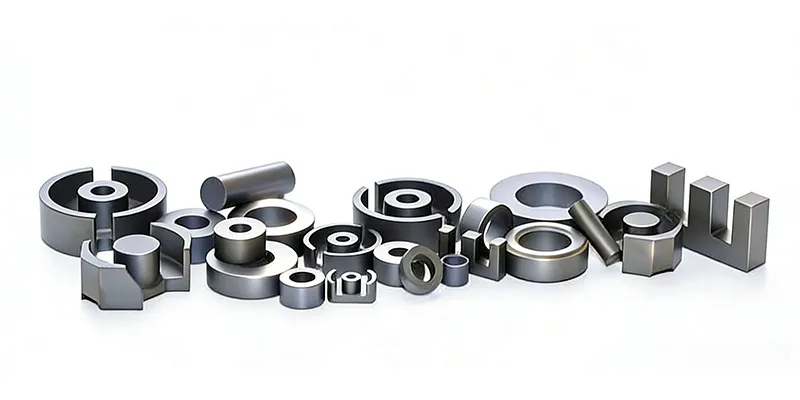
TOMITA PQ-type or toroidal cores with 2G8 material are commonly specified. For the highest current applications, consider using multiple parallel cores rather than pushing a single core toward saturation.
On-Board Charger (OBC) DC-DC Stage
The OBC converts AC mains to high-voltage DC to charge the battery pack. Its DC-DC stage typically operates at 100–300 kHz with SiC semiconductors, requiring ferrite cores that perform well at these frequencies with minimal losses.
Core requirements:
– Low loss at 100–300 kHz (SiC switching)
– High efficiency at partial load (most charging happens at partial state-of-charge)
– Thermal management compatibility with integrated OBC housing
EER-type or ETD-type cores with TOMITA 2G8A material are the primary choices for this power range (3.3–22 kW OBC ratings).
48V Mild-Hybrid DC-DC Converters
The 48V bus architecture common in mild hybrids (48V MAH, 48V ISG) uses DC-DC converters to interface between the 48V and 12V batteries. These converters typically operate at 100–200 kHz and handle 1–5 kW.
Core requirements are less demanding than traction applications, but reliability and cost remain important. EER-28 or ETD-29 cores with 2G8 material provide a cost-effective balance.
Battery Management System (BMS) Inductors
The BMS uses common-mode and differential-mode inductors for current sensing and EMI filtering. These are typically smaller signals, but still require stable magnetic properties across temperature.
High-permeability grades (2H5) are common here, though some designers prefer Ni-Zn materials for their better frequency response at the switching frequencies used in BMS ICs.
Meeting Automotive Quality Standards
Ferrite cores for automotive applications should be sourced from manufacturers with appropriate quality certifications:
– **IATF 16949** — the automotive quality management standard that supersedes ISO/TS 16949
– **AEC-Q200** — stress test qualification for passive components used in automotive environments
– **PPAP documentation** — Production Part Approval Process documentation for specific part numbers
TOMITA supplies automotive-grade ferrites with full documentation support for IATF 16949 and AEC-Q200 qualification. GRXElec can facilitate the documentation process for automotive customers sourcing through our distribution channel.
Design Tips for EV Ferrite Applications
1. **Derate aggressively**: Don’t design to the catalog specs at maximum temperature. Target 70–75% of maximum flux density at worst-case temperature to provide transient headroom.
2. **Consider thermal cycling**: If your application involves frequent thermal cycles (heavy driving patterns, extreme climates), specify cores with documented thermal shock performance and consider epoxy-coating or staking for the assembly.
3. **Watch for saturation at cold temperature**: Bsat increases at low temperature, which seems beneficial — but the real issue is that permeability also increases, which can cause inductors to saturate if they were designed for room-temperature operation. Verify saturation current at -40°C.
4. **Use proper cooling**: Many automotive ferrite failures aren’t magnetic — they’re thermal. Ensure the core is mounted with adequate thermal interface to the housing, and specify thermal interface material with appropriate hardness and conductivity for your vibration environment.
Conclusion
EV power electronics push ferrite cores harder than virtually any other application. The combination of high temperature, thermal cycling, lifetime requirements, and rising switching frequencies demands careful core selection — particularly in traction and charging applications.
TOMITA’s automotive-grade ferrite materials, combined with appropriate core geometries and thorough thermal validation, provide a reliable foundation for EV power converter design.
For technical support on EV ferrite selection, or to initiate automotive qualification documentation, contact the GRXElec engineering team.
Shenzhen Gaorunxin Technology Co., Ltd