

Ferrite vs. Iron Powder Cores: Choosing the Right Magnetic Material
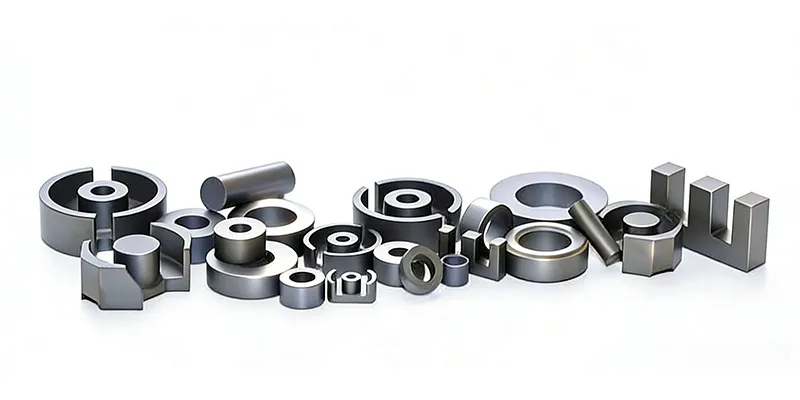
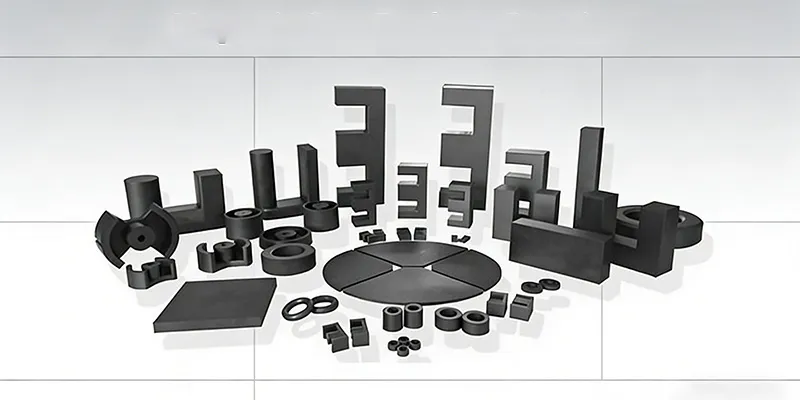
Not all magnetic cores are created equal. Ferrite and iron powder cores look similar at first glance — both are magnetic materials formed into toroidal or E-shaped cores — but their magnetic properties, frequency ranges, and applications are fundamentally different. Choosing between them is one of the most common decisions in power electronics design.
The Fundamental Difference in Structure
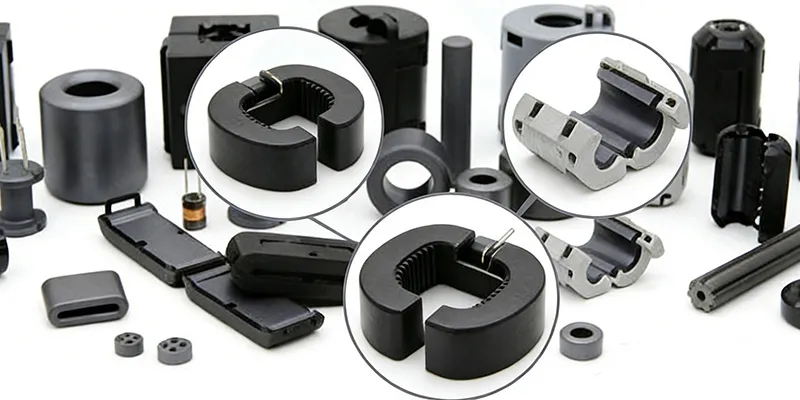
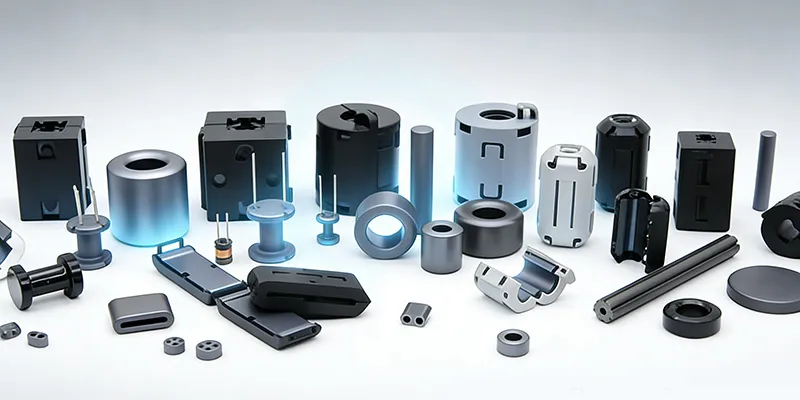
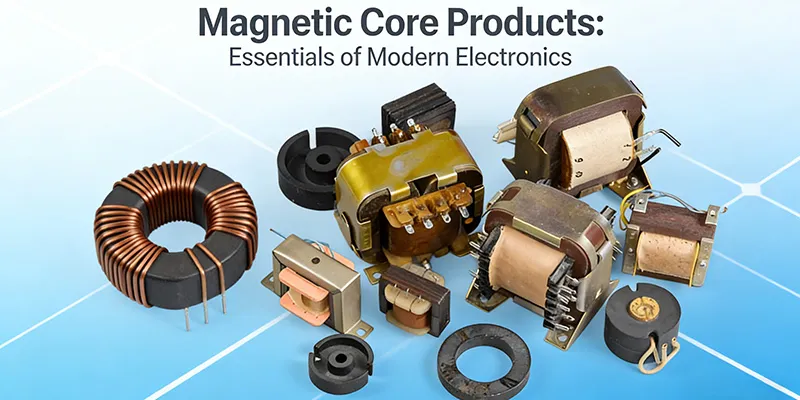
Ferrite cores are ceramic magnetic materials made from manganese-zinc (MnZn) or nickel-zinc (NiZn) compounds. Their crystal structure is uniform and dense, giving them high permeability but also making them brittle.
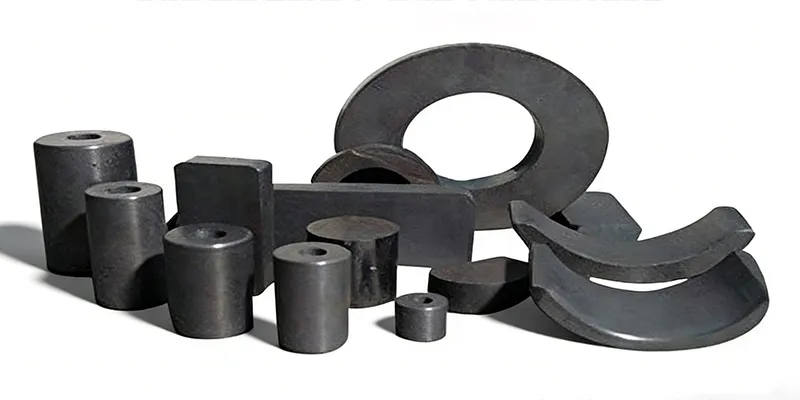
Iron powder cores are exactly what the name suggests: very fine iron particles, each insulated from one another by an organic or ceramic binder, then pressed and cured into the final core shape. The air gaps between particles are distributed throughout the core rather than concentrated in one location.
Permeability and Saturation Behavior
This structural difference drives their most important performance distinction:
- Ferrite cores have high permeability (typically μi = 1500–10,000 for MnZn) but saturate abruptly. A 20% increase in flux density above design limits can push the core well into saturation.
- Iron powder cores have lower permeability (typically μ = 35–125) but saturate gradually and forgivingly. The distributed air gap allows them to handle current surges without sharp saturation.
For applications with high DC bias currents — such as power factor correction (PFC) inductors or DC-DC converter inductors with significant average current — iron powder is often the more practical choice.
Frequency Range
Ferrite: Optimal from 20 kHz to ~3 MHz (MnZn) and 1 MHz to hundreds of MHz (NiZn). Below 20 kHz, ferrites become impractically large.
Iron powder: Effective from audio frequencies up to approximately 300 MHz. Below 50 kHz, iron powder cores are often the only practical choice for high-current inductors due to size and saturation constraints.
Loss Characteristics
Ferrite cores have lower core losses at medium frequencies (100–500 kHz), making them preferred for efficient switch-mode power supplies at typical switching frequencies. Iron powder cores have higher hysteresis loss at these frequencies but compensate with superior DC bias performance.
At very high frequencies (>5 MHz), iron powder performance degrades significantly; ferrite NiZn materials take over.
When to Choose Ferrite
- High-frequency power supply transformers (100 kHz–1 MHz)
- EMI suppression beads on signal and power lines
- Applications where compact size is critical and DC bias is low
- Common mode and differential mode chokes
- RF inductors and matching networks
When to Choose Iron Powder
- DC-DC converter inductors with significant DC current offset
- PFC inductors in power factor correction circuits
- High-current filter inductors
- Applications requiring saturation tolerance during transients
- Avoiding the cost and size penalty of large ferrites at low frequencies
Conclusion
The ferrite vs. iron powder decision is not about which material is "better" — it is about matching the magnetic material to the application profile. High frequency and compact size favor ferrite. High DC bias and robust saturation tolerance favor iron powder. Many power supplies use both: ferrite for the main transformer and iron powder for the output inductor.
Shenzhen Gaorunxin Technology Co., Ltd