

Future Horizons: The Role of Ferrite in Wireless Charging and the Low-Altitude Economy
Future Horizons: The Role of Ferrite in Wireless Charging and the Low-Altitude Economy
As we traverse the milestones of 2026, the meteoric rise of Wireless Power Transfer (WPT) and the low-altitude economy—specifically Electric Vertical Take-off and Landing (eVTOL) aircraft—has catalyzed a paradigm shift in material science. Ferrite, once relegated to the status of a “passive auxiliary,” has ascended to become the “quintessential energy engine.” By analyzing the maturation of TOMITA’s specialized product lines, we can decode the future trajectories of materials evolving toward unprecedented frequencies and energy densities.
1. The “Traffic Controllers” of Wireless Power: Magnetic Shielding and Coupling
In the complex architectures of modern smartphones, autonomous vehicular chargers, and robotic energy-replenishment systems, the primary engineering hurdles remain magnetic flux leakage and transmission inefficiency.
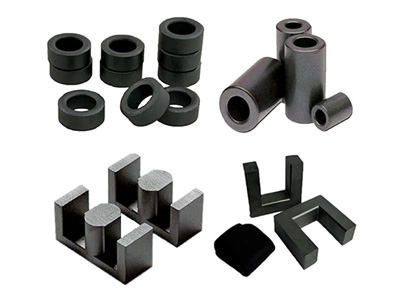
The Shielding Mechanism: By integrating high-permeability magnetic sheets—utilizing TOMITA’s specialized ultra-thin 2H5 Mn-Zn or flexible ferrite membranes—engineers can surgically refract dispersed magnetic flux lines back into the intended coupling zone.
The Coupling Advantage: This strategic redirect does more than merely protect surrounding lithium-ion cells and sensitive AFE (Analog Front-End) circuits from deleterious inductive heating. It acts as a “magnetic collimator,” drastically amplifying the coupling coefficient (k) and condensing the temporal footprint of the charging cycle.
2. Confronting the MHz Threshold: The High-Frequency/Low-Loss Vanguard
The technological zeitgeist of wireless power is rapidly shifting from the traditional hundreds of kilohertz toward the multi-megahertz spectrum, as seen in the A4WP and Qi2 evolutionary standards.
Breaching Material Thresholds: As conventional Mn-Zn ferrites encounter their hysteretic and eddy current frequency ceilings, TOMITA’s Ni-Zn (such as the 6D8) series illuminates the path forward. Possessing profound intrinsic resistivity, these materials remain virtually impervious to eddy current dissipation under high-frequency alternating magnetic fields.
2026 Design Philosophies: The meticulous documentation of high-frequency loss factors in current technical folios empowers engineers to architect ultra-slender, hyper-efficient resonant coils. This is particularly vital for thickness-sensitive wearable technologies and aerostatically optimized wireless charging platforms for drones.
3. The “Energy Chokepoint” of the Low-Altitude Economy
Within the propulsion and power distribution systems of eVTOLs and heavy-lift logistics UAVs, magnetic cores endure draconian operational stress.
High-Voltage Rectification: These aircraft typically utilize high-voltage DC platforms (800V or higher). TOMITA’s power-grade substrates ensure that even during extreme voltage fluctuations, the magnetic core maintains linear permeability and remains resilient against sudden saturation—a failure mode that could be catastrophic in-flight.
Structural Tenacity and Reliability: The idiosyncratic sintering processes utilized by TOMITA imbue these ferrites with a structural “self-healing” robustness. Under the incessant mechanical vibrations and G-loads of takeoff and landing, these cores maintain magnetic consistency for tens of thousands of hours, ensuring the absolute sanctity of flight safety.
4. Intelligence and Sustainability: The Green Material Footprint
TOMITA’s technical roadmap also articulates a profound commitment to ecological stewardship.
Environmental Equilibrium: Every ferrite component adheres to the rigorous RoHS and REACH mandates. This is no longer just a regulatory box to check; in 2026, it is a vital prerequisite for navigating global trade barriers and ESG (Environmental, Social, and Governance) requirements.
The Circular Economy: As an inorganic, non-metallic ceramic, ferrite is intrinsically more environmental-friendly in its reclamation and upcycling than rare-earth permanent magnets. It embodies the values of a “Green Industrial Revolution” by reducing the dependency on scarce precious metals.
5. Design Heuristics for the Future Architect
For engineers initiating vanguard projects in the 2026 landscape, the following selection heuristics are paramount:
Dynamic Simulation Over Static Data: In high-power wireless transfer, do not rely on zero-load parameters. Utilize SPICE models and 3D magnetic field simulations to anticipate caloric accumulation during peak power delivery.
Heteromorphic Morphology: Future hardware envelopes are rarely rectilinear. Leverage TOMITA’s precision-machining services to develop bespoke magnetic sheets that conform to the idiosyncratic geometries of modern device chassis, thereby harvesting every micrometer of available spatial “bonus.”
Conclusion: Although ferrite technology possesses a century-long lineage, the data from TOMITA reveals its most youthful and vibrant incarnation yet. From the liberation of cable-free energy replenishment to the silent propulsion of the skies, these minute magnetic cores are the silent drivers of a lighter, freer tomorrow.
Shenzhen Gaorunxin Technology Co., Ltd