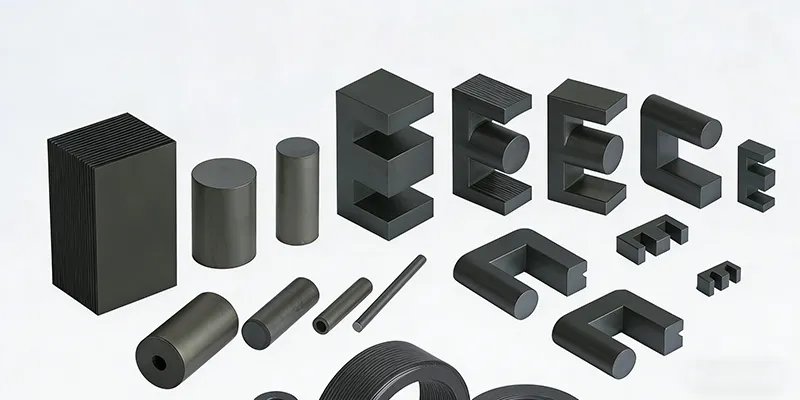


Mn-Zn vs. Ni-Zn: Orchestrating the Optimal Ferrite Selection for Your Design
In the labyrinthine process of inductor and transformer synthesis, the primary conundrum confronting an engineer is seldom localized to spatial dimensions. Rather, the crux of the challenge resides in the selection of the substrate. Ferrite materials are far from a monolithic entity; they are bifurcated by their chemical stoichiometry into two paramount categories: Manganese-Zinc (Mn-Zn) and Nickel-Zinc (Ni-Zn). Drawing from the rigorous technical repositories of the TOMITA September 2024 manual, deciphering the nuanced divergence between these two is the sine qua non of optimizing electronic circuit efficiency.
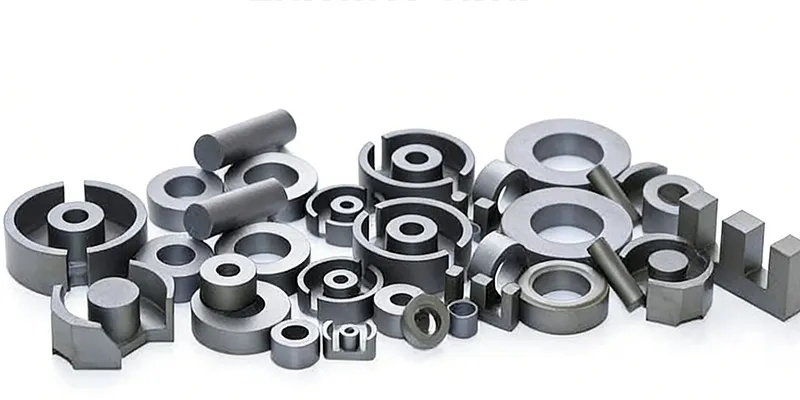
1. The Mn-Zn (Manganese-Zinc) Series: High-Permeability Power Sovereigns
Mn-Zn ferrites are distinguished by their formidable initial permeability (μ iac) and substantial saturation magnetic flux density (Bs). Within the TOMITA portfolio, the 2H5 and 2G8 series stand as the archetypal representatives of this category, engineered for magnetic dominance.
Elevated Permeability: Materials such as the 2H5 variant boast an initial permeability reaching 3700±25%. This characteristic facilitates the achievement of profound inductance levels even within relatively compact windings at lower spectral ranges.
Low-Frequency Predominance: The operational zenith for Mn-Zn typically resides below the 1 MHz threshold. Beyond this frequency, the material’s lower intrinsic resistivity renders it susceptible to energy dissipation.
Deployment Domains: These cores are the quintessential choice for switch-mode power transformers, AC line filters, and high-inductance energy storage components. If your architectural objective necessitates robust power transmission or the attenuation of low-frequency ripples, Mn-Zn remains the peerless candidate.
2. The Ni-Zn (Nickel-Zinc) Series: Vanguards of High-Frequency Interference Suppression
Departing from the characteristics of their Mn-Zn counterparts, Ni-Zn ferrites possess an extraordinary electrical resistivity. This property acts as a crystalline bulwark, ensuring that eddy current losses remain negligible even as the electromagnetic environment becomes increasingly frenetic. TOMITA’s 4A3 and 6D8 series epitomize this high-frequency resilience.
Sublime Resistivity: Ni-Zn substrates exhibit a resistivity several orders of magnitude higher than Mn-Zn. This isolation effectively forestalls parasitic heating and maintains signal integrity in high-speed applications.
Broadband Responsivity: These materials maintain functional stability across a vast spectrum, spanning from 1 MHz to several hundred MHz.
Deployment Domains: Ni-Zn is the preferred medium for EMI/EMC suppression components—such as beads and toroids—alongside high-frequency communication transformers and impedance matching networks. Their ability to decouple noise from high-speed data lines is indispensable in the modern digital landscape.
3. Core Comparative Metrology: A Logical Framework for Selection
Synthesizing the data from the TOMITA Material Characteristics Reference Table, we can delineate a precise selection logic based on the physical and magnetic imperatives of your design:
| Characteristic | Mn-Zn (e.g., 2H5) | Ni-Zn (e.g., 6D8) |
| Initial Permeability (μiac) | High (3700) | Moderate/Low (450) |
| Electrical Resistivity (ρ) | Relatively Low | Extremely High |
| Applicable Frequency | < 1 MHz | 1 MHz~500 + MHz |
| Saturation Flux Density (Bs) | Potent ≈ 450 mT | Modest ( approx ≈ 300 mT) |
| Primary Utility | Power Conversion, LF Filtering | Signal Integrity, HF EMI Shielding |
Shenzhen Gaorunxin Technology Co., Ltd