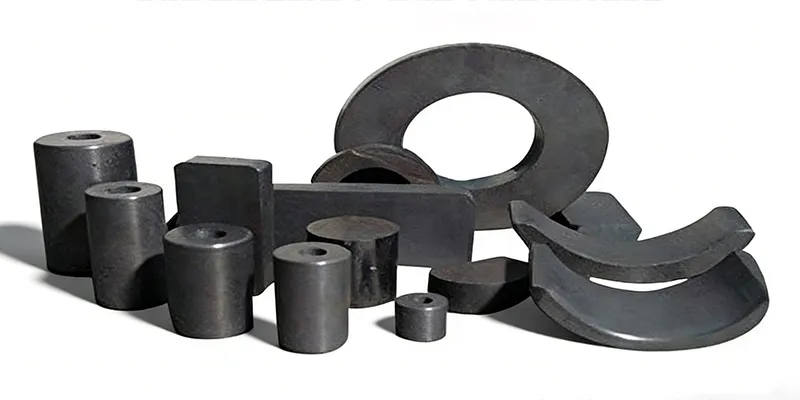


PC-Type Cores: Diverse Specifications for Rigorous Industrial Demands
When selecting ferrite cores for power electronics applications, engineers must weigh multiple factors: magnetic performance, EMI containment, power density, and mechanical compatibility. Among the various core geometries available, PC-type (Pot Core) ferrite cores have earned a reputation as a go-to solution for demanding industrial designs — and for good reason.
TOMITA's PC-type core series has become an industry reference for applications ranging from industrial power supplies to high-precision sensors. This article breaks down the key features, specifications, and selection criteria to help engineers make informed decisions.
1. What is a PC-Type Core?
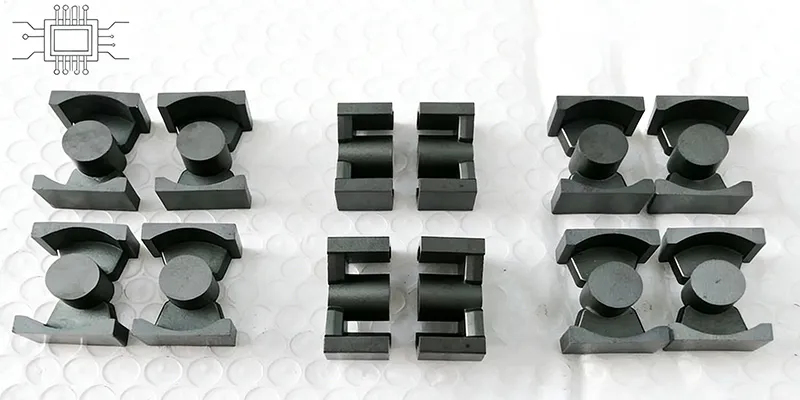
The PC-type core consists of two symmetrical "pot" halves that encase the wound bobbin when assembled. Unlike EER or ETD cores where the windings are partially exposed, the PC geometry wraps around the coil — creating a closed magnetic path that dramatically reduces flux leakage.
This design is particularly valued for its electromagnetic containment characteristics. The enclosed structure minimizes interference with nearby components while shielding the windings from external noise — a critical factor in dense PCB layouts.
2. Key Advantages of PC-Type Geometry
EMI Containment
Because nearly all magnetic flux stays within the ferrite housing, radiated EMI is significantly reduced. This makes PC cores ideal for noise-sensitive applications such as telecommunications equipment and medical electronics.
High Power Density
The PC configuration maximizes effective magnetic cross-sectional area (Ae) within a compact footprint. For modern modular power systems where board space is at a premium, this is a decisive advantage.
Mechanical Protection
The pot-style enclosure physically protects the windings from external damage, dust, and moisture — extending operational lifetime in harsh industrial environments.
3. Standard Dimensions and Parameters
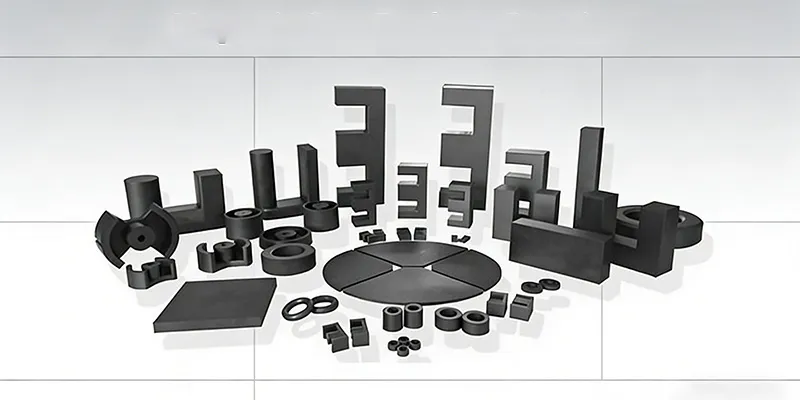
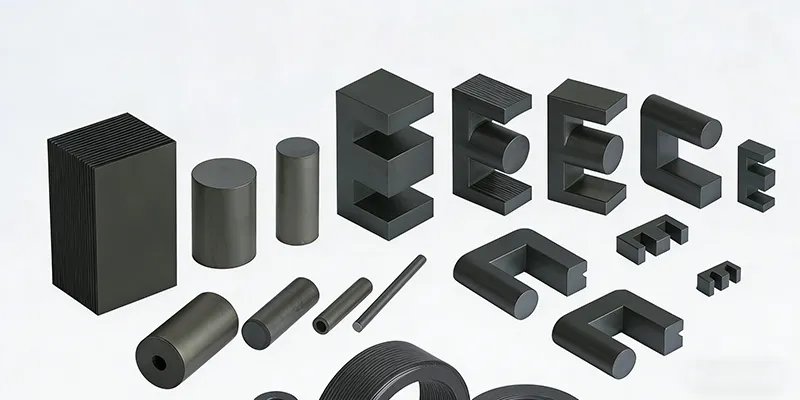
TOMITA's PC-type cores are available in a wide range of sizes, from sub-miniature models (PC-1.8X1.0) for micro-actuators to large cores for power inductors exceeding several kilowatts. Each size is characterized by:
- Ae — Effective cross-sectional area (mm²)
- le — Effective magnetic path length (mm)
- Ve — Effective core volume (mm³)
- Wa — Window area available for winding (mm²)
- AL Value — Inductance factor (nH/N²)
4. Material Options
TOMITA offers PC cores in multiple ferrite material grades to match different application requirements:
- 2H5 (Mn-Zn) — High permeability, suitable for high-inductance filters and telecom applications
- 2G8 (Mn-Zn) — Low loss at medium frequencies, ideal for general-purpose power conversion
- 4A3 (Ni-Zn) — Excellent high-frequency performance, optimized for switching frequencies above 500 kHz
5. Application Areas
PC-type ferrite cores serve a diverse range of industrial applications:
- DC-DC Converters — Enable compact, high-efficiency power conversion in industrial automation
- Power Factor Correction (PFC) Inductors — Handle high currents while maintaining low core losses
- Telecom Filter Inductors — Provide sharp frequency selectivity with minimal EMI emission
- Medical Isolation Transformers — Meet strict isolation and signal fidelity requirements
- Sensor Inductors — Used in position and displacement sensors requiring high stability
6. Customization Options
Beyond standard catalog models, TOMITA provides custom processing services:
- Air Gap Grinding — Precisely machined air gaps to prevent DC saturation in power inductors
- Custom Mounting Holes — Bespoke hole patterns for specific PCB mounting requirements
- Sample Service — Short lead times for non-standard prototypes
7. How to Select the Right PC Core
When evaluating PC-type cores for your design, consider these parameters in order:
- Operating Frequency — Determines the material grade (2H5, 2G8, or 4A3)
- Power Level — Drives the core size and Ae requirement
- Inductance Requirement — Sets the AL value and any required air gap
- Window Area — Must accommodate your winding scheme and current rating
- Mechanical Fit — Ensure the core dimensions match your PCB footprint and mounting
Conclusion
PC-type ferrite cores occupy a specialized niche in power magnetics — excelling where EMI containment, power density, and mechanical protection are paramount. TOMITA's extensive catalog, combined with customization capabilities and short sample lead times, makes them a strong choice for both prototype and production volumes.
For technical support, full datasheets, or to request samples, contact the GRXElec engineering team.
Shenzhen Gaorunxin Technology Co., Ltd