Welcome to our company!



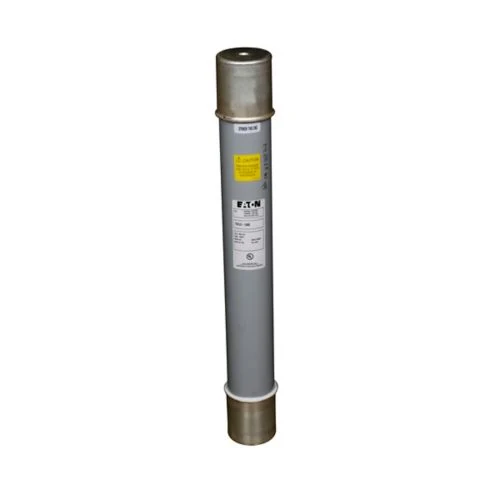
2CLE-65E Eaton Bussmann 2.4kV 65A Class E Fuse
Share
pEaton Bussmann 2CLE-65E, 2.4kV 65A Class E fuse, 50 kAIC interrupting./p
- Product Details
- Download
2CLE-65E Eaton Bussmann 2.4kV 65A Class E Fuse
At a Glance
- 2.4 kV rated voltage, 65 A rated current
- 50 kAIC interrupting rating
- Class E time-current characteristic
The Eaton Bussmann 2CLE-65E is a fuse with 2.4 kV rated voltage, 65 A rated current, 50 kAIC interrupting capacity, carrying a Class E time-current characteristic.
Specifications
General specifications
| UPC | 051712527453 |
| Product Length/Depth | 10.9 in |
| Product Height | 3 in |
| Product Width | 3 in |
| Product Weight | 9 lb |
Electrical rating
| Amperage Rating | 65 A |
| Interrupt rating | 50 kAIC |
| Voltage rating | 2.4 kV |
General information
| Class | Class E |
| Special features | Single barrel, Indoor |
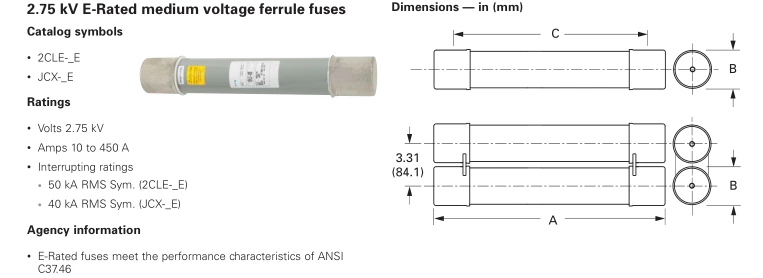
Series Selection Table
Applications
- Energy and utility distribution
- Industrial equipment
- Photovoltaic systems
Selection Notes
- Check the voltage rating against the system voltage, and the interrupting rating against the available fault current, before specifying.
Common Questions
What are the ratings of the Eaton Bussmann 2CLE-65E?
2.4 kV / 65 A, with a 50 kAIC interrupting rating.
How much fault current can the 2CLE-65E interrupt?
50 kAIC. The available fault current at the installation point must not exceed this value.
What does Class E mean for the 2CLE-65E?
Class E defines the fuse's time-current characteristic. E-rated fuses carry a defined melting curve so they coordinate predictably with upstream and downstream devices; mixing E and non-E ratings in one feeder defeats that coordination.
How should I select the 2CLE-65E for a circuit?
Match the voltage rating to the system voltage, keep the continuous current above the load current, and check that the interrupting rating exceeds the available fault current. In medium voltage work, select on the transformer or feeder fault level rather than the load current alone.
Shenzhen Gaorunxin Technology Co., Ltd
Online message
Shenzhen Gaorunxin Technology Co., Ltd