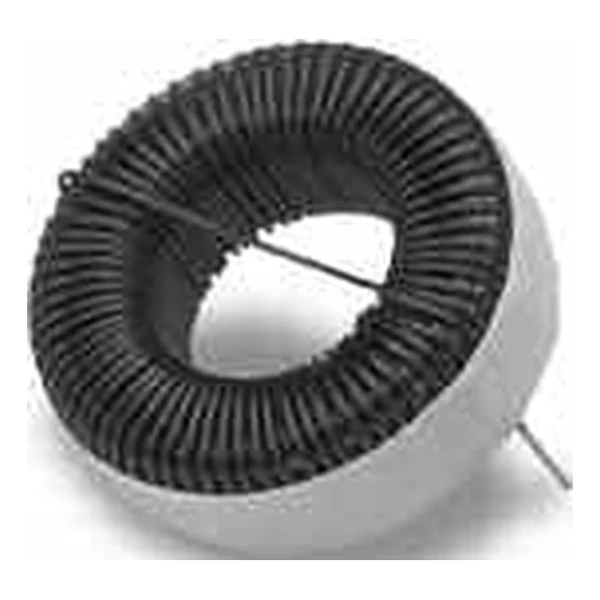
Eaton CTX500-1-52-R 505.0 uH Toroid Inductor, 1.7 A
- Product Details
- Download
Eaton CTX500-1-52-R 505.0 uH Toroid Inductor, 1.7 A
Ratings at a Glance
| Parameter | Value |
|---|---|
| Orderable part number | CTX500-1-52-R |
| Horizontal mount version | CTX500-1-52LP-R |
| Header mount version | CTX500-1-52M-R |
| Inductance | 505.0 uH ±20% |
| DCR maximum @ +25 °C | 361 mOhm |
| Idc | 1.7 A |
| Isat | 1.9 A |
| Volt-time rating | 77.9 V-us |
| Energy at Isat | 645 uJ |
| Mounting | Through-hole |
| Operating temperature | -40 °C to +105 °C |
| Qualification | Commercial grade |
| RoHS | Compliant, -R suffix |
| Data sheet | Eaton Technical Data 4304 |
Outline Drawing

Drawing reproduced from Eaton Technical Data 4304: outline with rated mm dimensions, pad layout and marking. Tolerances are stated on the drawing.
How to Read These Ratings
A toroid concentrates the magnetic path in a closed ring, so almost all of the flux stays inside the core. That is why toroids radiate little and why they are used where a filter inductor has to sit next to sensitive circuitry without a shield.
At 1.7 A the winding dissipates about 1.04 W in copper, using the 361 mOhm figure. That is the DC floor of the loss budget: ripple and core loss come on top of it.
Saturation is reached at 1.9 A. Beyond that point the inductance falls on the soft part of the curve, and the converter’s ripple grows faster than the load current does.
The core stores about 645 µJ at saturation, which is the energy available to bridge a load step before the control loop reacts.
The volt-time rating is 77.9 V-us: the applied volt-second product that produces a defined core loss. Exceed it and the core heats faster than the copper loss alone would suggest.
Within the CTX500 family this is value 2 of 2, in a range that runs from 499 to 505 uH.
What This Family Is For
The toroid family covers microhenry to tens of microhenry at currents up to a few amps, in vertical, horizontal and header-mounted versions of the same core.
- The winding is exposed; check the insulation against the working voltage before mounting the part against a chassis.
- Typical applications: filters; buck and boost switches; chokes.
- Design note: the three mounting variants share one electrical row, so a mechanical change does not require requalifying the magnetics.
Frequently Asked Questions
What does the energy column mean?
The energy stored at saturation current, in microjoules. It is the figure that connects inductance and current into a single transient capability.
Why are there three part numbers per row?
Vertical, horizontal and header-mounted versions of the same core and winding. The electrical values are identical; only the mounting differs.
Is the inductance stable with DC bias?
It falls as the core approaches saturation. The DC current column is the rated point; above it the inductance drops faster.
Shenzhen Gaorunxin Technology Co., Ltd
Online message
Shenzhen Gaorunxin Technology Co., Ltd