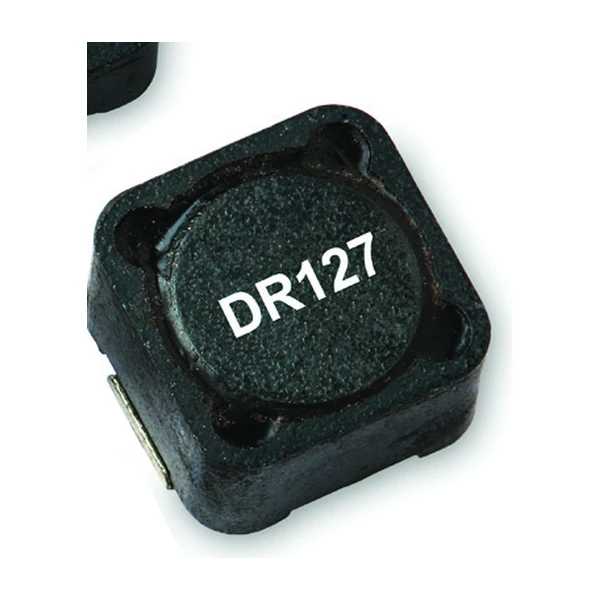
Eaton DR127-100-R 10 uH Shielded Drum Core Inductor
- Product Details
- Download
Eaton DR127-100-R 10 uH Shielded Drum Core Inductor
Ratings at a Glance
| Parameter | Value |
|---|---|
| Orderable part number | DR127-100-R |
| Rated inductance | 10 uH ±20% |
| Open circuit inductance (OCL) | 10.5 uH |
| Irms (40 °C rise) | 6.04 A |
| Isat | 11.2 A |
| DCR typical @ 20 °C | 17.2 mOhm |
| Volt-microsecond rating | 17.5 V-us |
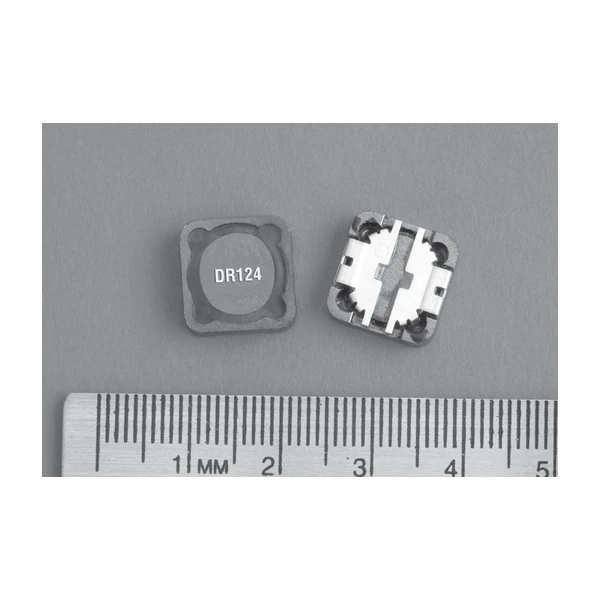
| Package | 12.5 x 12.5 mm footprint, 8.0 mm max height |
| Mounting | Surface mount |
| Operating temperature | -40 °C to +125 °C |
| Qualification | Commercial grade |
| RoHS | Compliant (-R suffix) |
Reading the Data Sheet
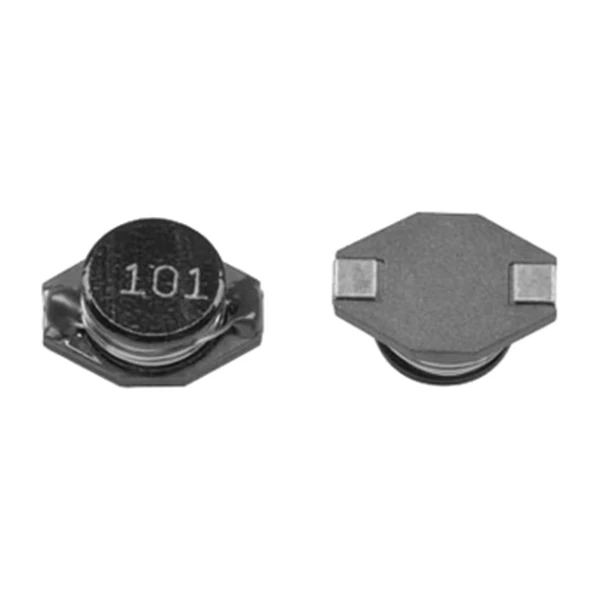
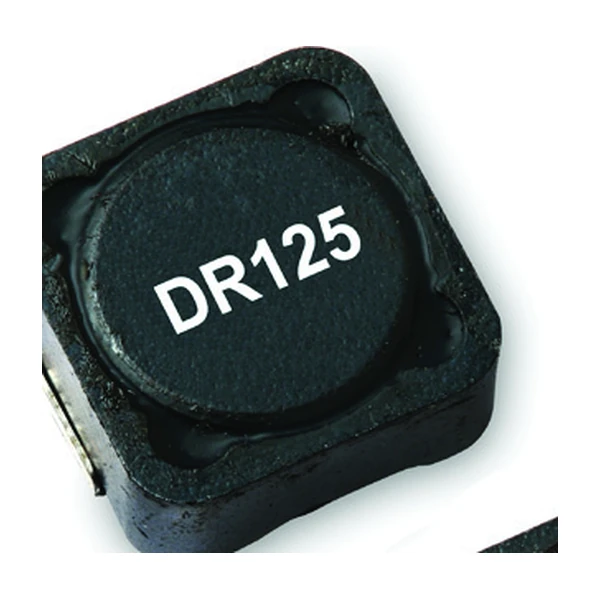
Every part on this page is a shielded drum core: a winding on a ferrite bobbin, capped by a ferrite shield. The construction sets both the inductance and the saturation behaviour, and it is why the same footprint can cover two decades of inductance without changing the land pattern.
At 17.2 mOhm this is a part where the winding, not the core, decides the temperature rise. The data sheet quotes the typical and the maximum separately for a reason: build your budget on the maximum.
Saturation degrades with temperature on ferrite. Isat is the peak current for approximately 30% rolloff at +20 °C, and the hot value is the one that matters under a hood or inside a sealed enclosure.
Series Positioning
DR127 is the 8.0 mm tall version of the 12.5 mm DR family and the one that carries the highest current in the range, up to 56 A peak. Same pad as DR125, more height, more copper, more current.
- Typical applications: High current DC-DC converters, servers and desktop power, graphics cards, battery powered systems, filter chokes.
- At 8 mm the part is tall enough to matter for mechanical clearance and for airflow around neighbouring components - check both before layout.
- Data sheet 4315.
Sizing It Into a Design
Choose 10 uH when the ripple target is in the middle of the design window: the DCR stays at 17.2 mOhm and the saturation limit at 11.2 A leaves the transient room it needs.
Thermal design is not optional here. The rated current assumes a 40 °C rise with the part in free air on a stated pad; inside a closed box, on a thin board, next to a hot IC, that assumption is gone.
Frequently Asked Questions
Is the "-R" suffix important?
Yes - it denotes the RoHS-compliant build. The same inductance without it is a different ordering code.
Can I run it above the rated current?
Briefly, if the peak stays below Isat and the average heating stays within the temperature rise the board can actually remove. There is no built-in protection.
Can I run it above the rated current?
Briefly, if the peak stays below Isat and the average heating stays within the temperature rise the board can actually remove. There is no built-in protection.
Design note: use the maximum DCR for the loss budget, keep the peak current below Isat with margin for the transient, and remember the 40 °C rise assumes free air on the recommended pad.
Mechanical Dimensions

Dimensional drawing and recommended PCB pad layout from the Eaton data sheet. Tolerances and pad dimensions are as printed on the drawing; check the outline against your layout before release.
Shenzhen Gaorunxin Technology Co., Ltd
Online message
Shenzhen Gaorunxin Technology Co., Ltd