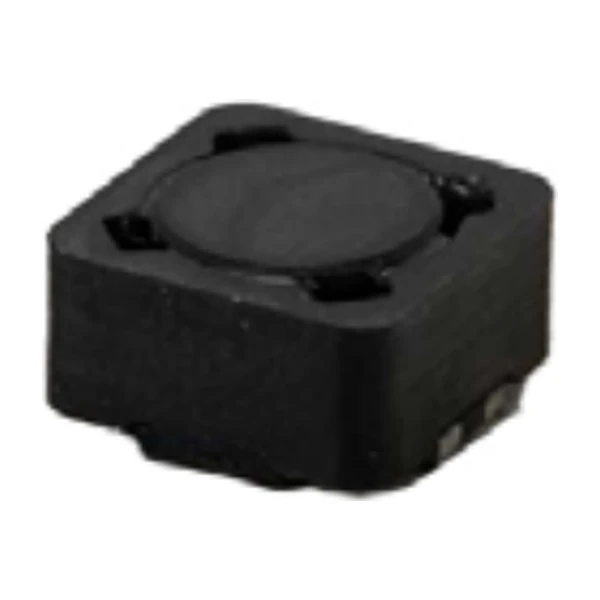
Eaton DRAQ75-680-R Shielded Coupled Inductor 68 uH 1.39 A
- Product Details
- Download
Eaton DRAQ75-680-R Shielded Coupled Inductor 68 uH 1.39 A
Specification Table
| Parameter | Value |
|---|---|
| Orderable part number | DRAQ75-680-R |
| Rated inductance | 68 uH ±20% |
| Open circuit inductance (OCL) | 68.3 uH |
| Irms (40 °C rise) | 1.39 A |
| Isat1 (30% rolloff @ +25 °C) | 1.11 A |
| Isat2 (40% rolloff @ +125 °C) | 0.89 A |
| DCR maximum @ 20 °C | 324 mOhm |
| K-factor (Bp-p = K x L x dI) | 31.7 |
| Series connection | 273 uH, 0.69 A |
| Parallel connection | 68 uH, 1.39 A |
| Turns ratio | 1:1, coupled |
| Package | 7.6 x 7.6 x 4.5 mm |
| Mounting | Surface mount |
| Operating temperature | -40 °C to +165 °C |
| Qualification | AEC-Q200 |
| RoHS | Compliant (-R suffix) |
What the Numbers Mean
A dual-winding drum core is a single core with two identical windings. Left uncoupled it is two chokes in one package; coupled, it becomes a 1:1 transformer for a SEPIC or a flyback, or a ripple-cancelling element in a multiphase converter.
Series mode is often mistaken for a way to get more current. It is the opposite - four times the inductance, half the saturation current, twice the DCR. Use it when you need inductance, not when you need amps.
Isat1 is the 30% rolloff point at +25 °C, Isat2 the 40% rolloff at +125 °C. In a buck converter the inductor current peaks at the top of the ripple, so the peak - not the average - is the number that has to stay below Isat with margin for the transient.
Where This Series Fits
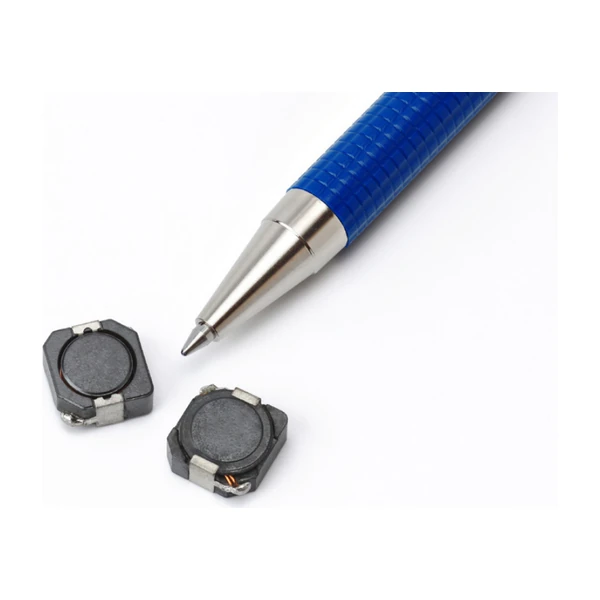
DRAQ75 is an AEC-Q200 dual-winding drum core in a 7.6 x 7.6 x 4.5 mm body, with 500 Vdc isolation between windings. Parallel for current, series for inductance, coupled for a 1:1 transformer in a SEPIC or flyback.
- Typical applications: Automotive LED drivers, body control modules, SEPIC and flyback converters, filter chokes.
- 500 Vdc winding isolation is the highest in this group - it is still a functional rating, not reinforced insulation for a mains barrier.
- Data sheet 11017.
Putting It to Work
68 uH sits in the middle of the range, and the trade at that point is explicit: - mOhm of DCR against 1.11 A of saturation headroom.
Thermal design is not optional here. The rated current assumes a 40 °C rise with the part in free air on a stated pad; inside a closed box, on a thin board, next to a hot IC, that assumption is gone.
Frequently Asked Questions
Which connection do I use?
Parallel for a high-current single inductor, series for high inductance at lower current, and coupled when you are building a SEPIC, flyback or a ripple-cancelling multiphase stage.
Which connection do I use?
Parallel for a high-current single inductor, series for high inductance at lower current, and coupled when you are building a SEPIC, flyback or a ripple-cancelling multiphase stage.
Which connection do I use?
Parallel for a high-current single inductor, series for high inductance at lower current, and coupled when you are building a SEPIC, flyback or a ripple-cancelling multiphase stage.
Design note: parallel and series ratings differ by about 4x. Read the column that matches the connection you intend to use, and keep the winding isolation rating in mind.
Mechanical Dimensions

Dimensional drawing and recommended PCB pad layout from the Eaton data sheet. Tolerances and pad dimensions are as printed on the drawing; check the outline against your layout before release.
Shenzhen Gaorunxin Technology Co., Ltd
Online message
Shenzhen Gaorunxin Technology Co., Ltd