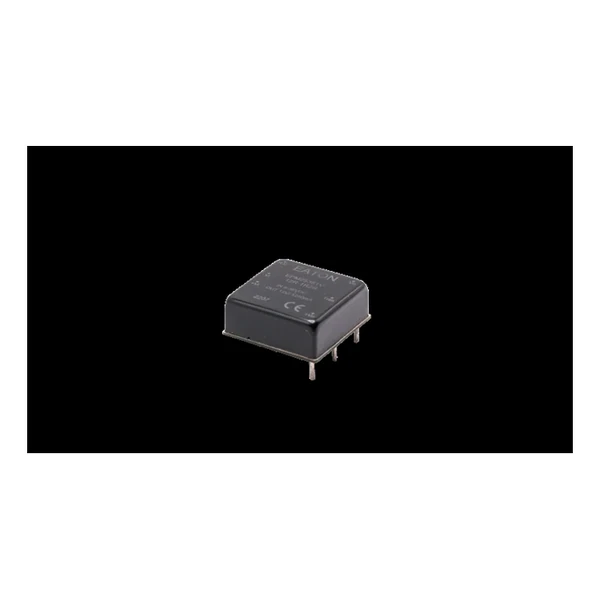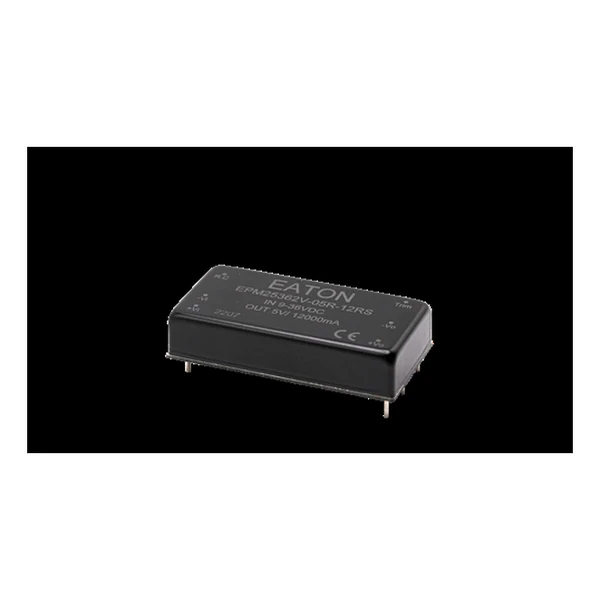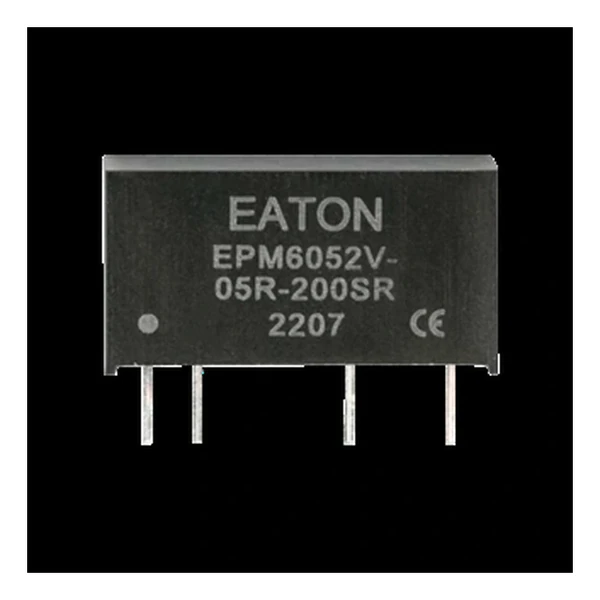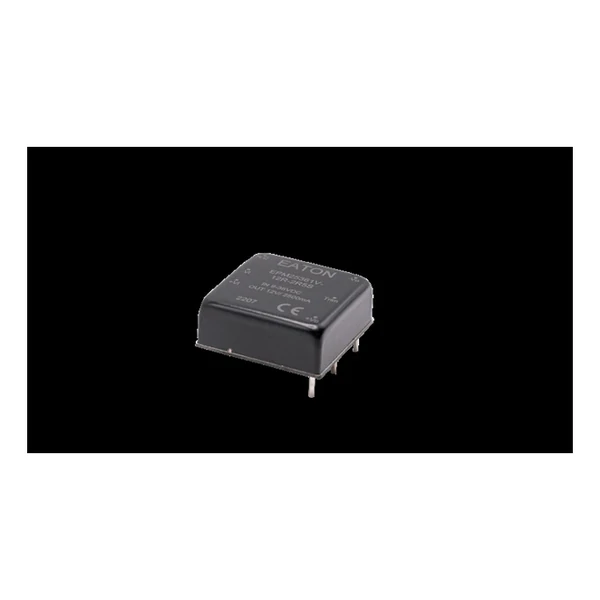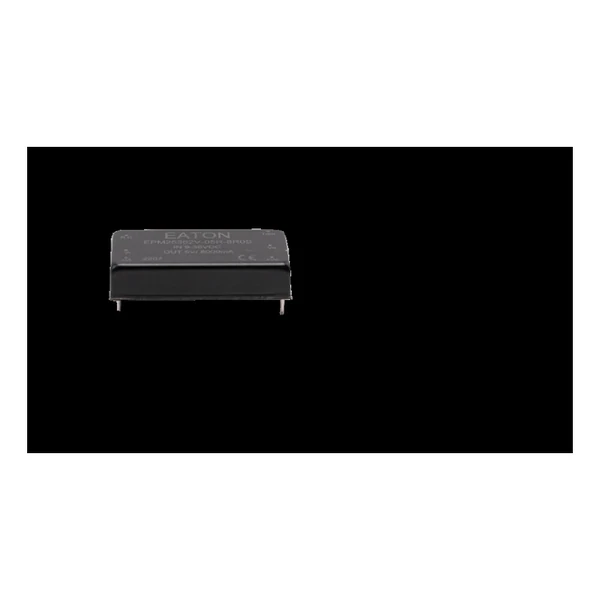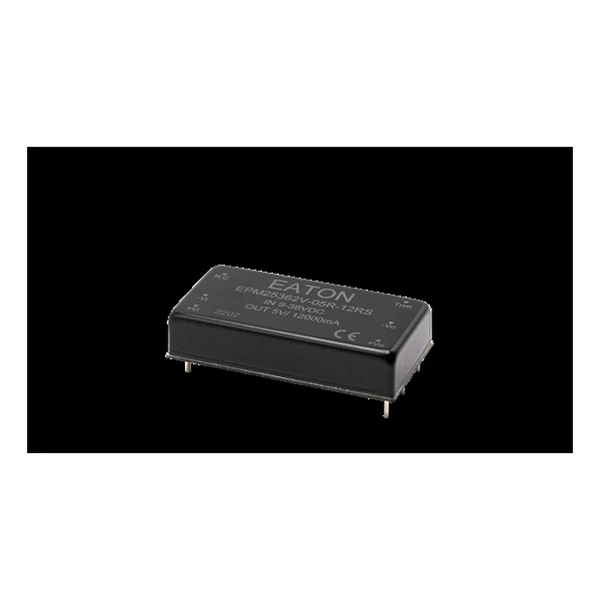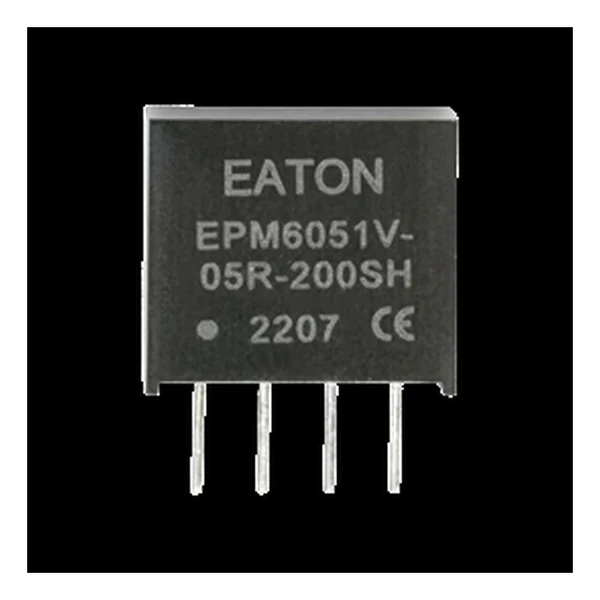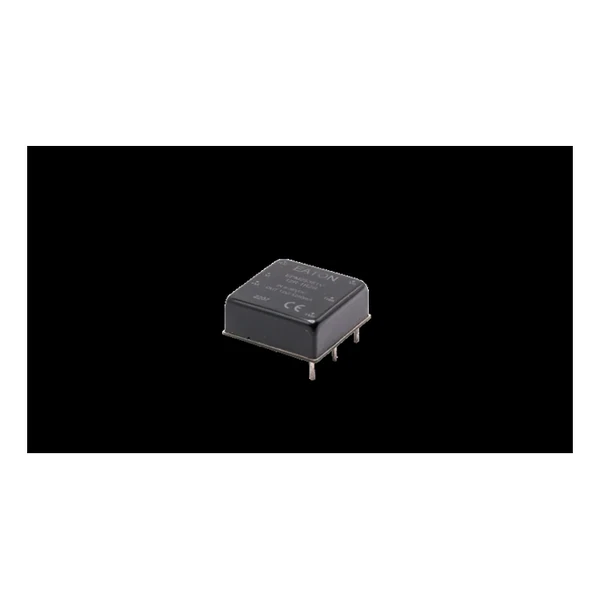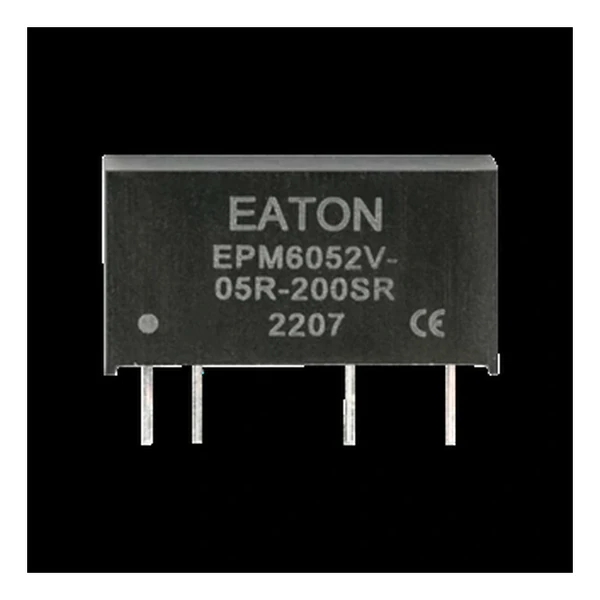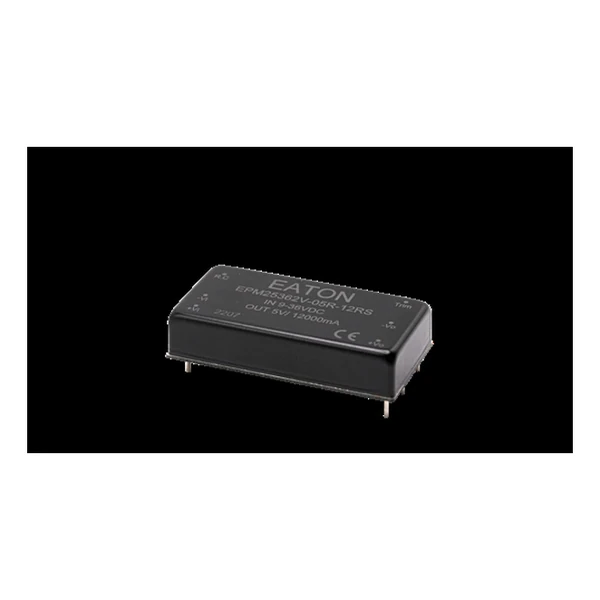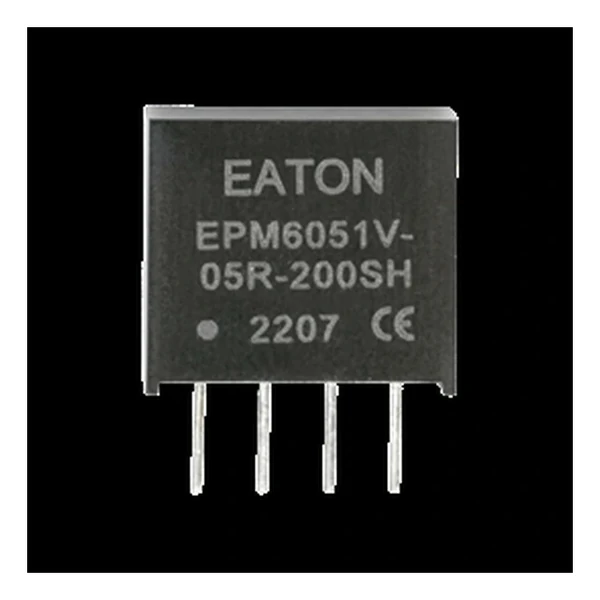
Eaton EPM6121V-3R3-303SH 3.3V 303mA Isolated DC-DC
- Product Details
- Download
Eaton EPM6121V-3R3-303SH 3.3V 303mA Isolated DC-DC
Key Specifications
| Parameter | Value |
|---|---|
| Orderable part number | EPM6121V-3R3-303SH |
| Input voltage range | 12 Vdc |
| Output voltage | 3.3 Vdc |
| Output current at full load | 303 mA |
| Output power | 1 W |
| Efficiency, minimum | 76 % |
| Efficiency, typical | 79 % |
| Capacitive load, maximum | 1500 uF |
| Isolation voltage | 1 kVdc |
| Isolation option | H = higher isolation voltage |
| Package | SIP |
| Operating temperature | -40 °C to +90 °C |
| Qualification | Industrial |
| RoHS | Compliant |
| Data sheet | Eaton Technical Data ELX1162 |
Mechanical drawing, derating curve and application circuits are on the
following pages of Eaton Technical Data ELX1162.
The Figures Explained
The converter is a fixed-frequency push-pull stage behind a transformer, potted into a case with the pins on a 2.54 mm grid. It needs no external components to run, which is the point: two decoupling capacitors and it works.
At 0.9999 W out and 79 % typical efficiency the module dissipates about 0.27 W. That is the number the thermal design has to carry, not the output power.
What This Family Is For
The 1 W isolated range covers 5, 12 and 24 V inputs with single or dual outputs from 3.3 V to 15 V, in SIP and DIP packages with standard or high isolation.
- The isolation barrier is only as good as the board creepage around it. Check the pad spacing, not just the module rating.
Frequently Asked Questions
What does the isolation voltage mean in practice?
It is the test voltage the barrier withstands, not a continuous working voltage. For reinforced insulation you also need the creepage on the board, which the module cannot provide on its own.
Why is the no-load input current specified?
Because a 1 W module can draw 20 to 30 mA with nothing connected. In a battery-powered design that idle current can be the dominant loss.
Why is the no-load input current specified?
Because a 1 W module can draw 20 to 30 mA with nothing connected. In a battery-powered design that idle current can be the dominant loss.
Shenzhen Gaorunxin Technology Co., Ltd
Online message
Shenzhen Gaorunxin Technology Co., Ltd