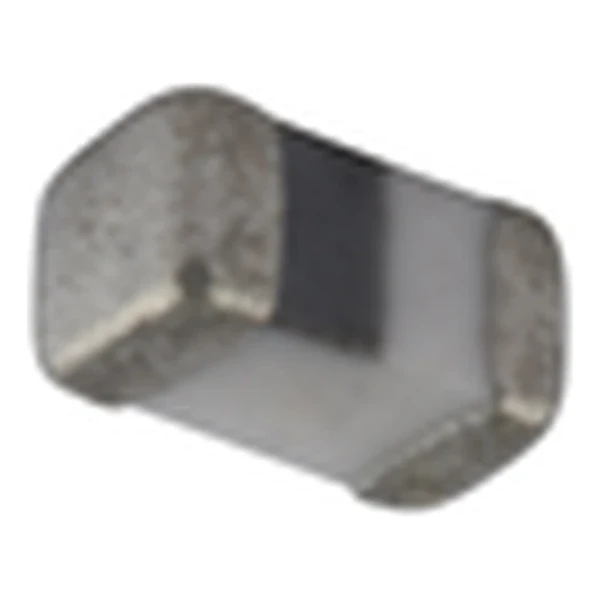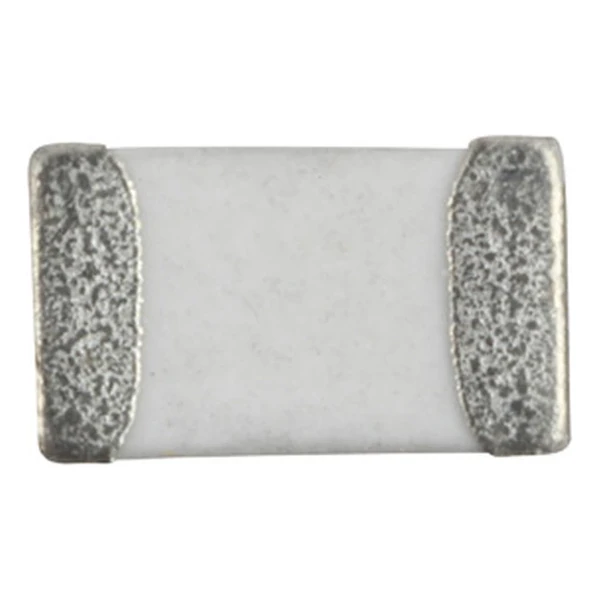
Eaton MCLA2012V1-5R6-R 5.6 uH Chip Inductor, 30 Q
- Product Details
- Download
Eaton MCLA2012V1-5R6-R 5.6 uH Chip Inductor, 30 Q
Key Specifications
| Parameter | Value |
|---|---|
| Orderable part number | MCLA2012V1-5R6-R |
| Inductance | 5.6 uH ±10 |
| Q minimum | 30 |
| DCR maximum @ +25 °C | 1000 mOhm |
| Rated current maximum | 15 mA |
| SRF minimum | 32 MHz |
| Test frequency | 4 MHz |
| Test voltage | 50 mV |
| Package | 2.0 x 1.25 mm |
| Size code | 2012 (0805) |
| Mounting | Surface mount |
| Operating temperature | -40 °C to +125 °C |
| Qualification | AEC-Q200 |
| RoHS | Compliant, -R suffix |
| Data sheet | Eaton Technical Data 10977 |
Mechanical Drawing
Outline drawing and pad layout are on page 2 of Eaton Technical Data 10977; the package column above gives the body size in millimetres.
What the Numbers Mean
The inductance here is a few nanohenry, which puts the part in RF and high-speed digital territory: matching networks, filter sections, bias chokes on amplifier supplies, and the small isolation inductors that keep clock harmonics out of connectors. The multilayer body keeps the parasitics predictable, and the Q column tells you how much loss the part adds at the test frequency.
The row reads 5.6 uH ±10 with a minimum Q of 30 at 4 MHz. Q is the ratio of reactance to resistance at that frequency, so a Q of 30 means the part’s loss is about 3.33 % of its reactance in that band.
Self-resonance is quoted as 32 MHz minimum. Below it the part is inductive; above it the inter-layer capacitance takes over. The margin between the operating band and 32 MHz is the design headroom.
Within the MCLA2012V1 family this is value 26 of 30, in a range that runs from 0.047 to 12 nH.
Series Positioning
The multilayer chip family covers nanohenry to a few microhenry values in 0402 through 1812 bodies. It is the range where the inductance is too small for a wound part to be practical and where the self-resonant frequency sets the usable band.
- The rated current is a thermal limit for the part in free air, not a saturation limit. At high ambient the current has to be derated.
- Typical applications: adas; infotainment; wireless communications; wifi, bluetooth, satellite; antenna tuning.
- Design note: compare SRF against the highest frequency the circuit will see, not just the fundamental.
Frequently Asked Questions
Can I replace a wire-wound chip with this part?
Only if the Q and the current rating suit the circuit. Multilayer parts have lower Q and lower current capability than wire-wound parts of the same size.
What happens above the self-resonant frequency?
The part becomes capacitive. Any filter or matching design has to keep the operating band below SRF, with margin for the tolerance of the value.
Can I replace a wire-wound chip with this part?
Only if the Q and the current rating suit the circuit. Multilayer parts have lower Q and lower current capability than wire-wound parts of the same size.
Shenzhen Gaorunxin Technology Co., Ltd
Online message
Shenzhen Gaorunxin Technology Co., Ltd