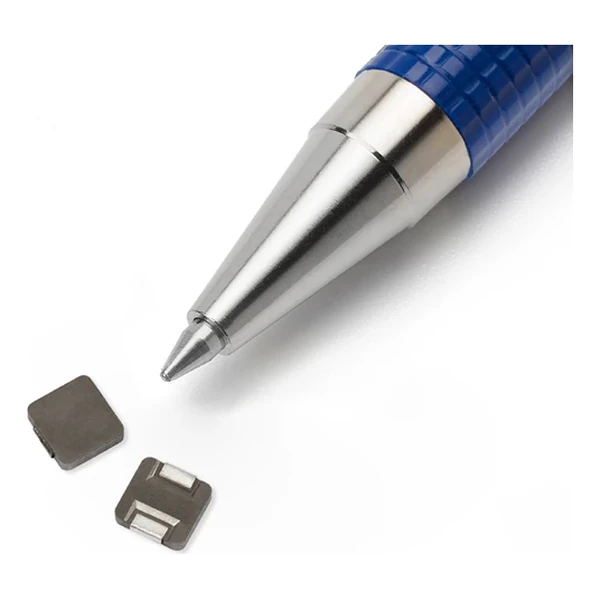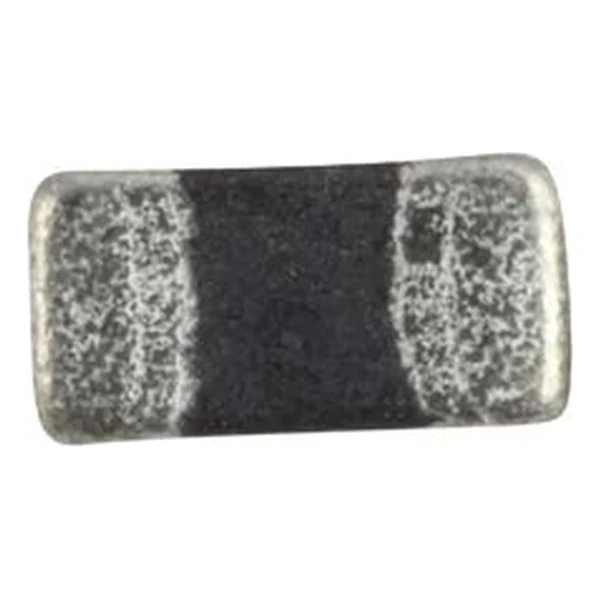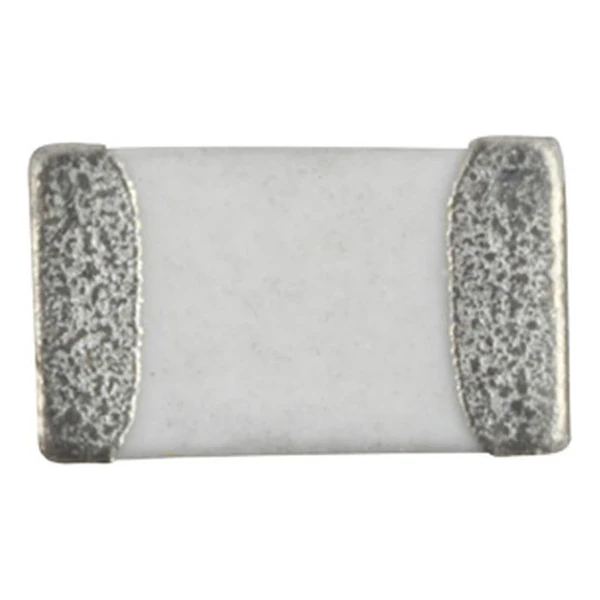
Eaton MCLA3225V1-8R2-R 8.2 uH SMD Inductor, SRF 20 MHz
- Product Details
- Download
Eaton MCLA3225V1-8R2-R 8.2 uH SMD Inductor, SRF 20 MHz
Ratings at a Glance
| Parameter | Value |
|---|---|
| Orderable part number | MCLA3225V1-8R2-R |
| Inductance | 8.2 uH ±10 |
| Q minimum | 35 |
| DCR maximum @ +25 °C | 700 mOhm |
| Rated current maximum | 400 mA |
| SRF minimum | 20 MHz |
| Test frequency | 4 MHz |
| Test voltage | 50 mV |
| Package | 3.2 x 2.5 mm |
| Size code | 3225 (1210) |
| Mounting | Surface mount |
| Operating temperature | -40 °C to +125 °C |
| Qualification | AEC-Q200 |
| RoHS | Compliant, -R suffix |
| Data sheet | Eaton Technical Data 10979 |
Mechanical Drawing
Outline drawing and pad layout are on page 2 of Eaton Technical Data 10979; the package column above gives the body size in millimetres.
The Figures Explained
Where a circuit needs a small, stable inductance in a package measured in millimetres, the multilayer chip is the default. Its self-resonant frequency is the practical ceiling – above it the part behaves like a capacitor, so the SRF column is the first thing to check against the operating band.
The row reads 8.2 uH ±10 with a minimum Q of 35 at 4 MHz. Q is the ratio of reactance to resistance at that frequency, so a Q of 35 means the part’s loss is about 2.86 % of its reactance in that band.
Self-resonance is quoted as 20 MHz minimum. Below it the part is inductive; above it the inter-layer capacitance takes over. The margin between the operating band and 20 MHz is the design headroom.
Within the MCLA3225V1 family this is value 12 of 14, in a range that runs from 1 to 12 nH.
Series Positioning
The multilayer chip family covers nanohenry to a few microhenry values in 0402 through 1812 bodies. It is the range where the inductance is too small for a wound part to be practical and where the self-resonant frequency sets the usable band.
- The rated current is a thermal limit for the part in free air, not a saturation limit. At high ambient the current has to be derated.
- Typical applications: adas; infotainment; wireless communications; wifi, bluetooth, satellite; antenna tuning.
- Design note: compare SRF against the highest frequency the circuit will see, not just the fundamental.
Frequently Asked Questions
How much does the value drift with temperature?
The data sheet gives the tolerance band; the drift inside that band is small for this construction because there is no mechanical winding to move.
What happens above the self-resonant frequency?
The part becomes capacitive. Any filter or matching design has to keep the operating band below SRF, with margin for the tolerance of the value.
Can I replace a wire-wound chip with this part?
Only if the Q and the current rating suit the circuit. Multilayer parts have lower Q and lower current capability than wire-wound parts of the same size.
Shenzhen Gaorunxin Technology Co., Ltd
Online message
Shenzhen Gaorunxin Technology Co., Ltd