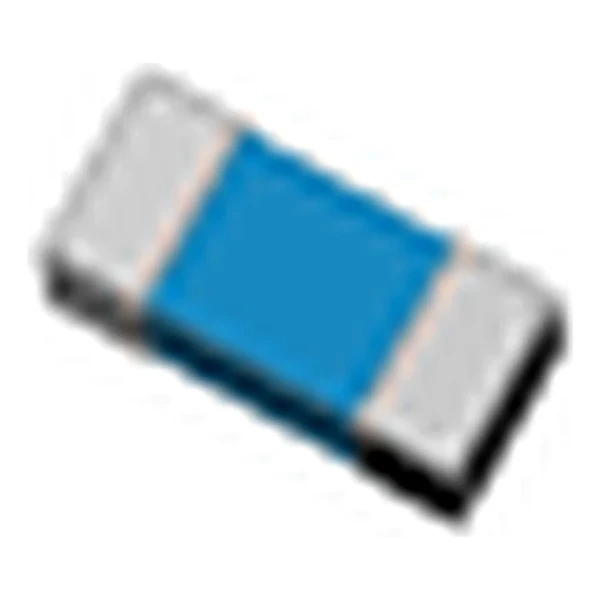
Eaton MLVC22V056C1000 2220 Chip Varistor 56 Vdc
- Product Details
- Download
Eaton MLVC22V056C1000 2220 Chip Varistor 56 Vdc
Electrical Specifications
| Parameter | Value |
|---|---|
| Orderable part number | MLVC22V056C1000 |
| Working voltage, DC | 56 Vdc |
| Working voltage, AC | 40 Vac |
| Varistor voltage at 1 mA | 72 V ±10% |
| Clamping voltage at 1 A | 127 V |
| Energy absorption, 10/1000 us | 2.5 J |
| Peak current, 8/20 us | 600 A |
| Typical capacitance at 1 MHz | 1000 pF |
| Package | 2220 (5750 metric) |
| Mounting | Surface mount |
| Operating temperature | -55 °C to +125 °C |
| Qualification | Commercial grade |
| RoHS | Compliant, halogen free |
| Data sheet | Eaton Technical Data 11236 |
Dimensions, recommended pad or hole pattern and the derating curves are
on the data sheet pages; the package line above gives the body size as Eaton states it.
What the Numbers Mean
A multilayer varistor sits across a signal or supply rail and does nothing until the voltage crosses its breakdown point, at which it turns into a low impedance and diverts the transient. The value that matters for the protected chip is not the varistor voltage but the clamping voltage at the surge current you expect.
The clamp column works out at 1.76 times the varistor voltage: 127 V at the rated current against 72 V at 1 mA. That ratio is what the downstream part has to survive, not the 72 V figure on the label.
The 1000 pF typical capacitance is the cost of the clamp. On a power rail it is irrelevant; on a data line it is the reason to look at the low-capacitance versions of the same voltage.
Within the MLVC high energy family this is item 64 of 97 in the Eaton catalogue.
Positioning in the Range
The part goes across the line it protects, as close to the connector or the cable entry as the layout allows. Lead length matters: every extra millimetre of trace between the connector and the varistor adds inductance and raises the voltage the protected chip actually sees.
- A varistor is not a zener. It has no sharp knee, so it conducts a little at the working voltage and the leakage column is the honest measure of that.
- The response time is quoted below a nanosecond because the ceramic turns conductive in the grain boundaries, not because of a junction.
Frequently Asked Questions
Is the varistor voltage the same as the working voltage?
No. The working voltage is the continuous DC or AC level the part can sit at; the varistor voltage is measured at 1 mA and is typically 1.5 to 2 times higher. Sizing on the varistor voltage would put the part into conduction on a normal rail.
What does the capacitance do to my signal?
It loads the line. At 1 MHz a 100 pF part is about 1.6 kOhm of reactance, which is harmless on a power rail and fatal on a 480 Mbit USB pair. Choose a low-capacitance version when the line carries data.
How many ESD strikes can it take?
The ESD rating is a qualification level, not a lifetime count. IEC 61000-4-2 level 4 is 8 kV contact and 15 kV air, and the part is expected to survive repeated strikes at that level because the energy per strike is small.
Shenzhen Gaorunxin Technology Co., Ltd
Online message
Shenzhen Gaorunxin Technology Co., Ltd