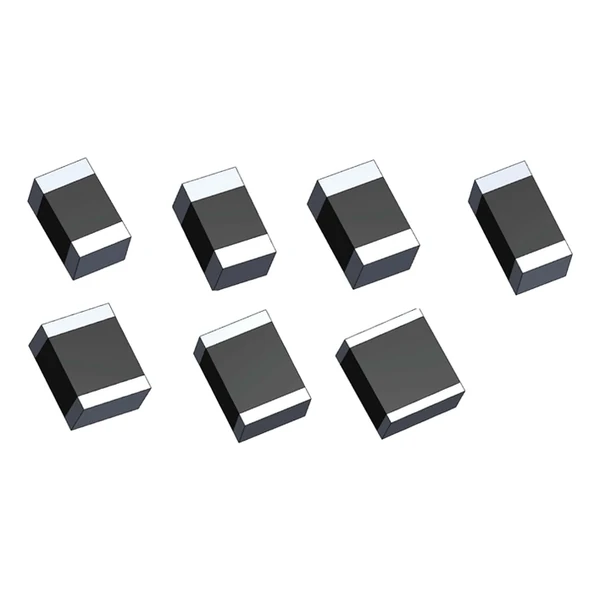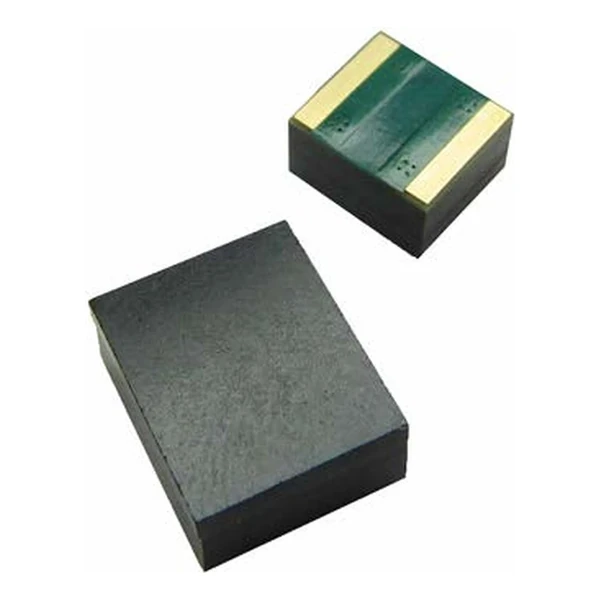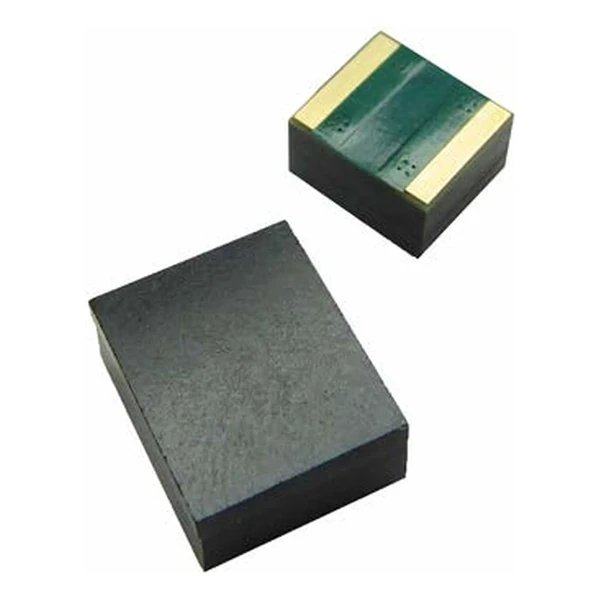
Eaton MLVC40V056C2000 Multilayer Varistor, 127 V Clamp
- Product Details
- Download
Eaton MLVC40V056C2000 Multilayer Varistor, 127 V Clamp
Key Specifications
| Parameter | Value |
|---|---|
| Orderable part number | MLVC40V056C2000 |
| Working voltage, DC | 56 Vdc |
| Working voltage, AC | 40 Vac |
| Varistor voltage at 1 mA | 68 V ±10% |
| Clamping voltage at 1 A | 127 V |
| Energy absorption, 10/1000 us | 3 J |
| Peak current, 8/20 us | 250 A |
| Typical capacitance at 1 MHz | 2000 pF |
| Package | 4032 (10280 metric) |
| Mounting | Surface mount |
| Operating temperature | -55 °C to +125 °C |
| Qualification | Commercial grade |
| RoHS | Compliant, halogen free |
| Data sheet | Eaton Technical Data 11236 |
Dimensions, recommended pad or hole pattern and the derating curves are
on the data sheet pages; the package line above gives the body size as Eaton states it.
The Figures Explained
These parts are zinc oxide ceramics sintered into a chip, so the response is faster than a junction device and there is no wear-out mechanism below the rated energy. What does degrade them is repeated energy above the rating, which shows up as a falling varistor voltage.
The clamp column works out at 1.87 times the varistor voltage: 127 V at the rated current against 68 V at 1 mA. That ratio is what the downstream part has to survive, not the 68 V figure on the label.
The 2000 pF typical capacitance is the cost of the clamp. On a power rail it is irrelevant; on a data line it is the reason to look at the low-capacitance versions of the same voltage.
Within the MLVC high energy family this is item 89 of 97 in the Eaton catalogue.
Where This Series Fits
Place it on the connector side of any series impedance. A varistor behind a common-mode choke protects the choke and not the connector, which is usually the wrong way round.
- The energy rating assumes a single pulse. Repeating the same transient heats the body faster than the datasheet curve suggests, because the curve is drawn for one event at a time.
- The response time is quoted below a nanosecond because the ceramic turns conductive in the grain boundaries, not because of a junction.
Frequently Asked Questions
What happens if the part is run above its working voltage?
Leakage rises steeply and the body heats. A varistor is not a clamp with a sharp knee, so continuous operation above the rating is a slow degradation, not an immediate failure.
Does the package size change the electrical ratings?
Yes, the energy and peak current scale with the body volume, so a 0402 and a 1206 of the same voltage are not interchangeable on a surge.
Is the varistor voltage the same as the working voltage?
No. The working voltage is the continuous DC or AC level the part can sit at; the varistor voltage is measured at 1 mA and is typically 1.5 to 2 times higher. Sizing on the varistor voltage would put the part into conduction on a normal rail.
Shenzhen Gaorunxin Technology Co., Ltd
Online message
Shenzhen Gaorunxin Technology Co., Ltd