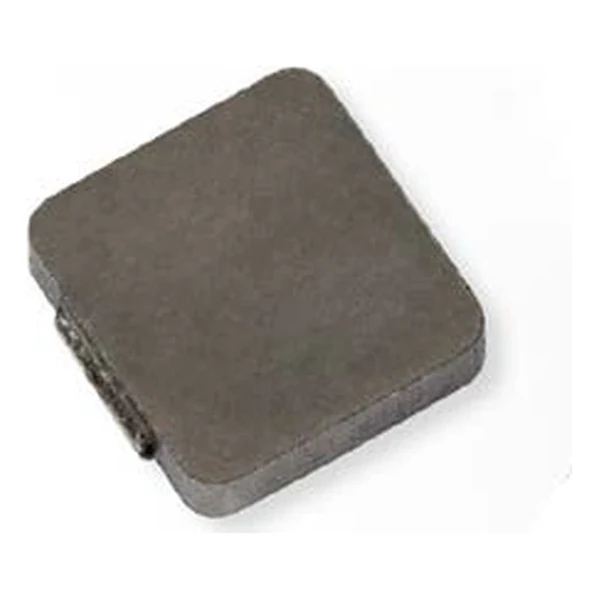
Eaton MPIA4020V3-4R7-R 4.7 uH AEC-Q200 Inductor 98 mOhm
- Product Details
- Download
Eaton MPIA4020V3-4R7-R 4.7 uH AEC-Q200 Inductor 98 mOhm
Ratings at a Glance
| Parameter | Value |
|---|---|
| Orderable part number | MPIA4020V3-4R7-R |
| Inductance | 4.7 uH |
| FLL minimum (at Isat) | 2.63 uH |
| DCR typical @ +20 °C | 98 mOhm |
| DCR maximum @ +20 °C | 118 mOhm |
| Irms (DC, 40 °C rise) | 2.7 A |
| Isat | 3.2 A |
| SRF typical | 28 MHz |
| K-factor | 859 |
| Mounting | Surface mount |
| Operating temperature | -55 °C to +125 °C |
| Qualification | AEC-Q200 |
| RoHS | Compliant, -R suffix |
| Data sheet | Eaton Technical Data ELX1486 |
Mechanical Dimensions & Pad Layout

Drawing reproduced from Eaton Technical Data ELX1486: outline with
rated mm dimensions, pad layout and marking.
Reading the Data Sheet
This is a surface-mount power inductor with a distributed-gap core. The energy is stored through the volume of the magnetic material rather than a single gap, which produces the gradual rolloff and keeps the fringing field small.
At 2.7 A the winding dissipates about 0.714 W in copper using the typical DCR of 98 mOhm. That is the DC floor of the loss budget – ripple and core loss come on top.
The core stores about 24.1 uJ at the saturation point, which is the energy available to bridge a load step.
Self-resonance is 28 MHz typical. Keep the operating band, and the harmonics that carry energy, below it.
The K-factor of 859 converts inductance and ripple into flux swing; read the core-loss curve at that amplitude.
Within the MPIA4020V3 family this is value 12 of 16, in a range from 0.1 uH to 22 uH.
Where This Series Fits
The MPIA family is the automotive miniature power range: AEC-Q200 qualified, low profile, in sizes from 2 mm to 4 mm, with both typical and maximum DCR quoted for every row.
- DCR is quoted at +20 °C; copper rises about 0.4 % per °C, so the hot loss is higher than the cold figure.
- Typical applications: body electronics; central body control module; vehicle access control system; headlamps, tail lamps and interior lighting and led lighting; doors, window lift and seat control.
- Design note: ripple from OCL, thermal from Irms, transient from Isat. Three numbers, three checks.
Frequently Asked Questions
Why two DCR columns?
Typical and maximum. A guaranteed thermal design uses the maximum; a nominal efficiency calculation can use the typical.
What is the difference between Irms and Isat?
Irms is the DC current for the rated temperature rise; Isat is the peak current at a defined inductance rolloff. A converter can exceed Irms briefly but must stay inside Isat.
What is the difference between Irms and Isat?
Irms is the DC current for the rated temperature rise; Isat is the peak current at a defined inductance rolloff. A converter can exceed Irms briefly but must stay inside Isat.
Shenzhen Gaorunxin Technology Co., Ltd
Online message
Shenzhen Gaorunxin Technology Co., Ltd