Eaton RL1011-122-R 1203 uH Leaded Drum Core Inductor
- Product Details
- Download
Eaton RL1011-122-R 1203 uH Leaded Drum Core Inductor
Key Specifications
| Parameter | Value |
|---|---|
| Orderable part number | RL1011-122-R |
| Inductance | 1203 uH |
| DCR typical @ +20 °C | 2130 mOhm |
| Irms (DC, 40 °C rise) | 0.379 A |
| Isat | 0.43 A |
| SRF typical | 1 MHz |
| Mounting | Through-hole |
| Operating temperature | -40 °C to +125 °C |
| Qualification | Commercial grade |
| RoHS | Compliant, -R suffix |
| Data sheet | Eaton Technical Data 10278 |
Mechanical Dimensions & Pad Layout

Drawing reproduced from Eaton Technical Data 10278: outline with
rated mm dimensions, pad layout and marking.
The Figures Explained
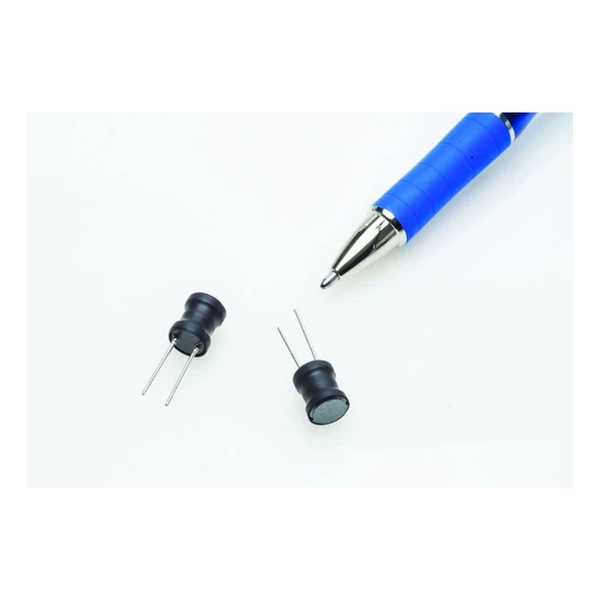
Radial leaded inductors are the traditional choice for power supplies that are wave-soldered and repaired in the field. The sleeve protects the winding and gives the part a defined outside diameter for placement.
At 0.379 A the winding dissipates about 0.306 W in copper using the typical DCR of 2130 mOhm. That is the DC floor of the loss budget – ripple and core loss come on top.
The core stores about 111 uJ at the saturation point, which is the energy available to bridge a load step.
Self-resonance is 1 MHz typical. Keep the operating band, and the harmonics that carry energy, below it.
Within the RL1011 family this is value 17 of 19, in a range from 4.43 uH to 2204 uH.
What This Family Is For
The RL family is the radial leaded drum core range: through-hole parts with a protective sleeve, covering microhenry to millihenry values.
- The leads and the plated holes are part of the current path. Check them, not just the winding, against the rated current.
- Typical applications: led drivers and lighting; utility meters; appliance electronics; motor drives; power supplies.
- Design note: leave clearance around the part for the sleeve and for the field. The inductance depends on nearby metal.
Frequently Asked Questions
What current can the leads carry?
The Irms column is the thermal rating for the part; the lead and the plated hole also have to be checked at that current.
What current can the leads carry?
The Irms column is the thermal rating for the part; the lead and the plated hole also have to be checked at that current.
Why a sleeve over the winding?
It protects the coil during handling and gives the part a defined outside diameter for automated placement.
Shenzhen Gaorunxin Technology Co., Ltd
Online message
Shenzhen Gaorunxin Technology Co., Ltd