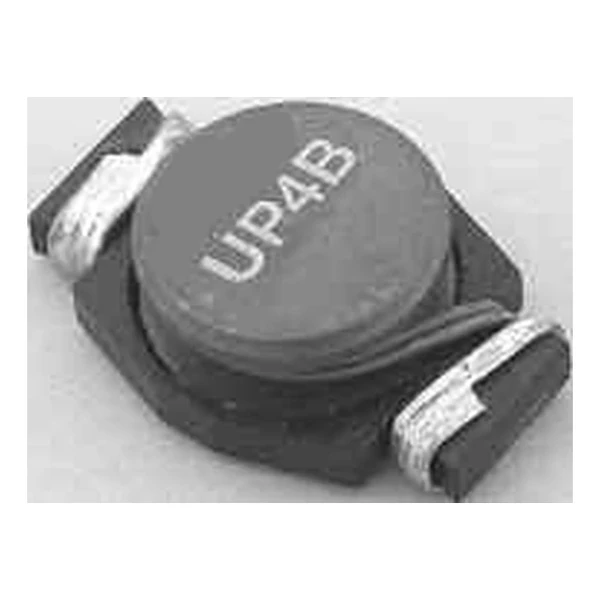
Eaton UP4B-221-R 220 uH Drum Core Inductor, 1.4 A
- Product Details
- Download
Eaton UP4B-221-R 220 uH Drum Core Inductor, 1.4 A
Ratings at a Glance
| Parameter | Value |
|---|---|
| Orderable part number | UP4B-221-R |
| Rated inductance | 220 uH ±20% |
| OCL (open circuit inductance) | 221 uH ±20% |
| Irms (40 °C rise, no core loss) | 1.4 A |
| Isat (peak, rolloff per data sheet) | 2.4 A |
| DCR typical @ +20 °C | 357 mOhm |
| Package | Four body sizes in this data sheet – see drawing |
| Mounting | Surface mount |
| Operating temperature | -40 °C to +125 °C |
| Qualification | Commercial grade |
| RoHS | Compliant, -R suffix |
| Data sheet | Eaton Technical Data DS4308 |
Outline Drawing

Drawing reproduced from Eaton Technical Data DS4308: outline views
with rated mm dimensions, pad layout and marking.
How to Read These Ratings
The construction is one piece – drum, winding, terminations – which is why the family reaches 1000 uH in a package a few millimetres across while staying a surface-mount part. Values below 1 uH and above 500 uH sit in the same body size.
Copper loss at the 1.4 A rating is about 0.7 W with the typical DCR of 357 mOhm. Ripple current adds to that through the AC resistance.
The core holds about 634 uJ at the saturation point, which is the energy available to bridge a load step before the inductance collapses.
Within the UP4B family this is value 16 of 18, in a range from 0.47 to 470 uH.
Where This Series Fits
The UP family runs from 0.47 uH to 1000 uH in bodies from 6.6 x 4.45 mm up to 18.54 x 15.24 mm, all unshielded drum core, all with the saturation and thermal ratings quoted separately.
- Unshielded. Do not route traces or vias underneath the body, and keep the drum axis away from sensitive nodes and from any magnetic sensor.
- Typical applications: buck or boost inductor; workstations/servers; desktop computer; dvd players; portable power devices.
- Design note: on the high-value rows the core saturates well before the winding reaches its thermal limit. Size against Isat for those values.
Frequently Asked Questions
Why is DCR quoted in ohms on some of these data sheets?
Because the values are large: a 1000 uH part can be several ohms. The table on this page converts the figure to milliohm so it can be compared directly with the rest of the family.
How far does the field reach?
The drum is open at both ends, so the field leaves along the axis and returns around the body. Keep traces and vias out from under the part and keep sensitive nodes off the axis. A shielded part is the answer when that is not possible.
How far does the field reach?
The drum is open at both ends, so the field leaves along the axis and returns around the body. Keep traces and vias out from under the part and keep sensitive nodes off the axis. A shielded part is the answer when that is not possible.
Shenzhen Gaorunxin Technology Co., Ltd
Online message
Shenzhen Gaorunxin Technology Co., Ltd