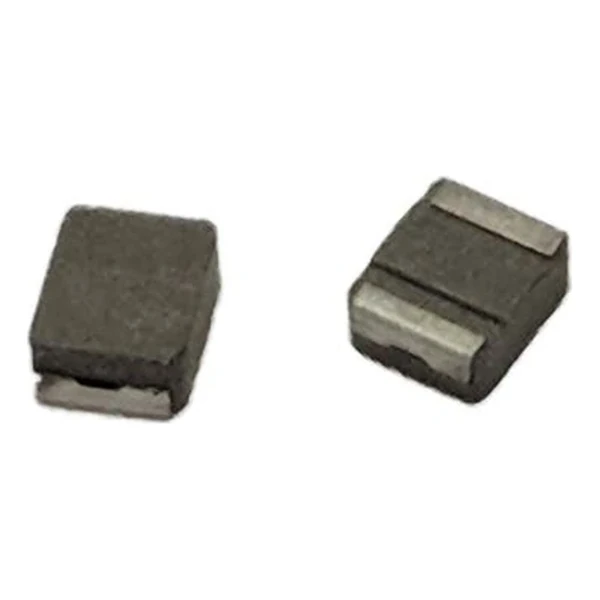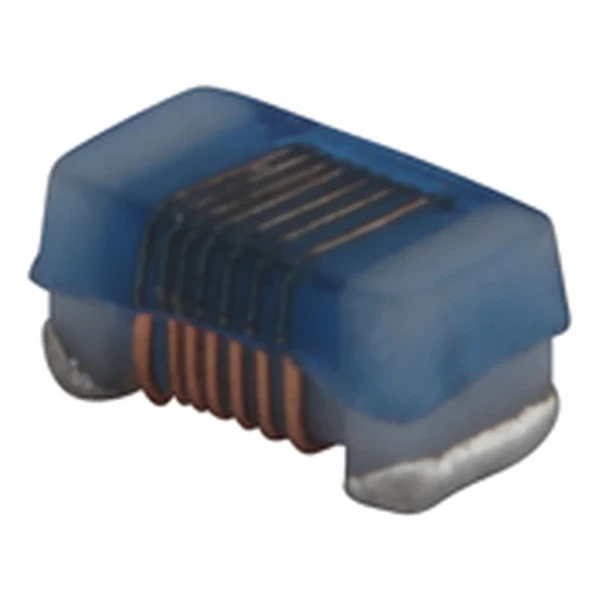
Eaton WCLA1608V1-471-R 470 nH Wire Wound Chip Inductor
- Product Details
- Download
Eaton WCLA1608V1-471-R 470 nH Wire Wound Chip Inductor
Ratings at a Glance
| Parameter | Value |
|---|---|
| Orderable part number | WCLA1608V1-471-R |
| OCL | 470 nH ±5% |
| Q minimum @ test frequency | 25 @ 100 MHz |
| SRF minimum | 700 MHz |
| DCR maximum @ +25 °C | 7000 mOhm |
| Rated current (20 °C rise) | 75 mA |
| OCL test frequency | 100 MHz |
| OCL test voltage | 500 mV |
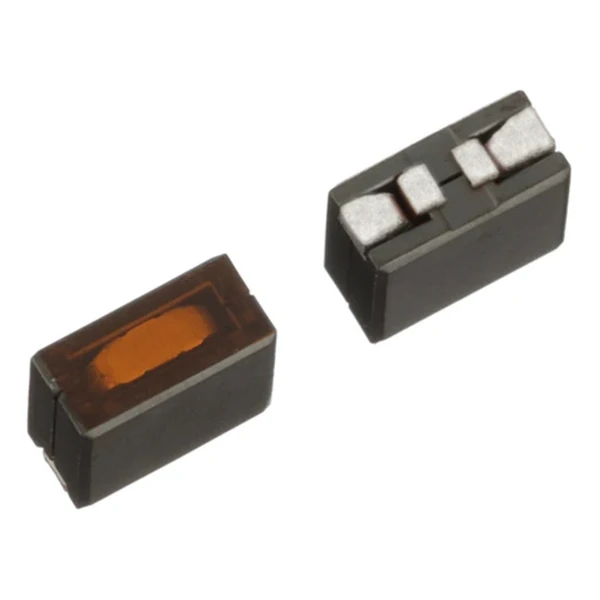
| Package | 1.78 x 1.10 mm, 0.95 mm high |
| Mounting | Surface mount |
| Operating temperature | -40 °C to +125 °C |
| Qualification | AEC-Q200 |
| RoHS | Compliant, -R suffix |
| Data sheet | Eaton Technical Data 10982 |
Mechanical Dimensions & Pad Layout

Drawing reproduced from Eaton Technical Data 10982: outline views
with rated mm dimensions, pad layout and marking.
Reading the Data Sheet
This is a wire wound chip inductor for RF and small-signal circuits: tight tolerance, defined Q, and a rated current that is set by a 20 °C self-temperature rise rather than by saturation.
At the 75 mA rating the winding drops about 525 mV and dissipates 39.4 mW. Both are small enough to ignore in a bias network but not in a high-Q filter.
Q of 25 at 100 MHz with self-resonance at 700 MHz puts the useful band comfortably below the point where the winding capacitance takes over.
Within the WCLA1608V1 family this is value 31 of 31, in a range from 1.6 to 470 nH.
Positioning in the Range
The WCL and WCLA families run from 1.0 nH in a 1.19 x 0.66 mm body to 560 uH in 3.5 x 2.9 mm, with Q quoted at a stated test frequency for every row.
- The rated current is a 20 °C rise figure, not a saturation limit. In a DC bias application check the inductance at the actual bias before sizing the filter.
- Typical applications: adas; infotainment; wireless communications; wifi, bluetooth, satellite; antenna tuning.
- Design note: read Q and SRF at the frequency the part works at, not at the test frequency printed in the table.
Frequently Asked Questions
What does the rated current mean here?
It is the current that produces a 20 °C self-temperature rise, not a saturation limit. On a ceramic-core part there is no saturation to speak of, so the thermal figure is the only limit.
Can I place it with a standard chip shooter?
Yes, the body and terminals are dimensioned for tape and reel and standard nozzle placement. Check the terminal width against the pad geometry in the drawing.
Is the automotive version electrically different?
The construction is the same; the qualification and the temperature range are not. The WCLA parts are AEC-Q200 qualified and rated to +125 °C, the commercial WCL parts to +85 °C.
Shenzhen Gaorunxin Technology Co., Ltd
Online message
Shenzhen Gaorunxin Technology Co., Ltd